06 Sep Best Fiber Optic Cabling Providers for Campuses 2026
Universities need fiber that survives 15 to 20 years of dorm renovations, new STEM buildings, and traffic loads nobody predicted when the backbone went in — picking the wrong installer means re-trenching conduit twice inside a decade.
Best overall for tri-state campuses: a regional structured cabling specialist like DBSI. Best for large multi-building state university systems: a national low-voltage integrator. Best budget or short-notice option: an electrical contractor offering fiber as an add-on service. Best for day-to-day moves and small repairs: an in-house campus IT or facilities team. Best for dorm-only or single-building drops: a telecom carrier-affiliated installer.
- Regional structured cabling specialists win for tri-state campuses needing single-vendor accountability through 2026 and beyond.
- Best fiber optic cabling providers for universities and campuses differ mainly in project size, not fiber quality.
- National integrators fit large state systems; electrical contractors fit fast, budget-capped single buildings.
- In-house IT teams handle moves and adds but rarely own new backbone installs or certification.
- Cable testing and certification records matter more long-term than the installer’s name on the invoice.
Why this matters
A campus fiber backbone isn't a phone jack you swap out next quarter. Once conduit is buried between buildings or run through a utility tunnel, that pathway is fixed for the life of the campus — the fiber inside it gets refreshed maybe once every 15 to 20 years if the initial design was done right.
Get the provider choice wrong and a university ends up trenching the same pathway twice: once for the original install, once a few years later when someone realizes the fiber count or the termination quality wasn't sized for growth. That's the actual cost of picking on price alone.
The five provider categories below aren't interchangeable. Each one is built for a different campus size, timeline, and ownership model, and picking the wrong category is a bigger risk than picking the wrong vendor inside the right category.
What makes the best fiber optic cabling provider for a campus
- Single point of accountability — one team designs, pulls, terminates, and certifies, so nobody can blame the other guy when a link fails
- TIA/EIA-compliant testing and documentation — every run certified and labeled, not just "it worked when we plugged it in"
- Experience with campus-scale pathways — utility tunnels, building-to-building conduit, and multi-tenant risers, not just office suites
- Realistic strand-count planning — enough dark fiber reserved for the next building addition, not just today's headcount
- Local response time — a campus network outage during finals week can't wait on a vendor three states away
- Coordination with existing systems — cabling that plugs cleanly into the campus's phone, Wi-Fi, and security camera infrastructure instead of creating five separate contractors to blame
Fiber optic cabling providers for campuses: at a glance
| Provider type | Best for | Standout feature | Key limitation |
|---|---|---|---|
| Regional structured cabling specialist (DBSI) | Tri-state private and mid-size campuses | Single vendor for design, pull, and certification | Smaller crew size limits simultaneous multi-site jobs |
| National low-voltage integrator | Large multi-building state university systems | Bench strength for simultaneous building rollouts | Slower local response; more layers between you and the tech |
| Electrical contractor with cabling add-on | Fast, budget-capped single-building jobs | Already on-site for electrical work, easy to bundle | Fiber usually secondary to their core trade, less specialization |
| In-house campus IT/facilities team | Ongoing moves, adds, and small repairs | Zero dispatch delay for daily tickets | Rarely certified or staffed for new backbone builds |
| ISP/telecom-affiliated installer | Dorm-only or single-building internet drops | Bundled with the internet service itself | Built around the carrier's service, not the campus's long-term network |
1. Regional structured cabling specialist: best for tri-state campuses
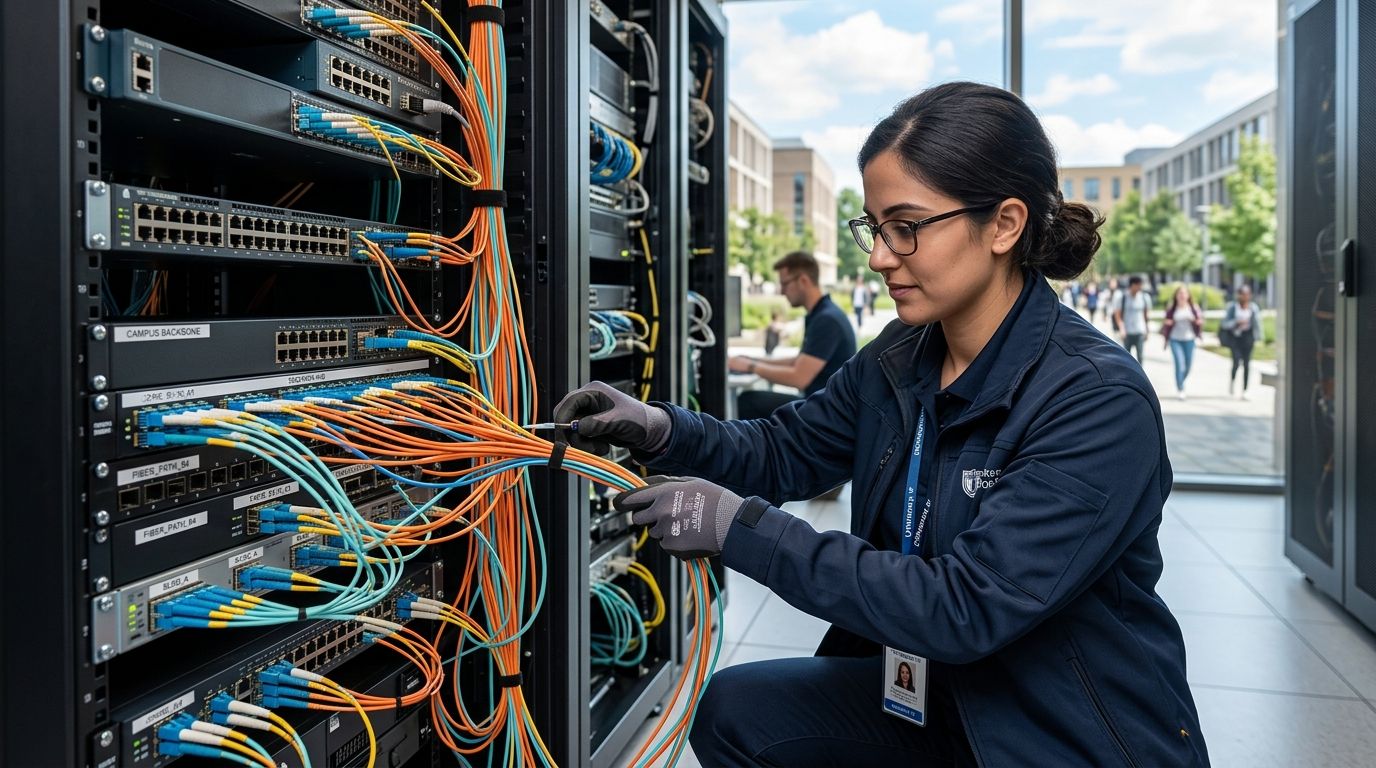
A regional specialist like DBSI designs, pulls, terminates, and certifies fiber runs for small and mid-sized campuses in New Jersey and the surrounding area, usually alongside the copper, Wi-Fi, and phone infrastructure the same buildings need. The work covers backbone runs between buildings as well as the horizontal cabling inside them, which matters when a college wants one team responsible for the whole network instead of five separate invoices.
Regional specialist pros:
- One team owns design through certification, so there's no finger-pointing between contractors
- Familiar with structured cabling for data centers and server rooms that campus network closets actually need
- Faster on-site response for a campus in the same region, which matters during a semester-start outage
- Can bundle fiber backbone work with fiber optic backbone cabling for office buildings-style projects across multiple campus buildings
Regional specialist cons:
- Not built for a state university system running ten buildings at once across three campuses
- Smaller crew means longer timelines if a project needs to happen overnight during a break week
Best for: private colleges, community colleges, and mid-size campuses in the tri-state area. Verdict: Recommended for any tri-state campus under roughly a few hundred thousand square feet planning a new backbone or a major refresh in 2026.
2. National low-voltage integrator: best for large state university systems
National integrators bring crews large enough to run cabling across a dozen buildings at once, which is the actual use case they're built for — a state system opening three new dorms and a research center in the same fiscal year.
National integrator pros:
- Enough staff to run parallel crews across multiple buildings simultaneously
- Established project management processes for large capital projects
- Usually carries bonding capacity required for public university procurement
National integrator cons:
- Slower local response after the project closes out — a fiber cut during the semester can mean waiting for a regional dispatch
- More management layers between the campus facilities director and the technician actually pulling cable
- Often less flexible on schedule changes than a regional team
Best for: state university systems with multiple simultaneous building projects. Verdict: Recommended for large-scale rollouts, Wait if the project is a single building — the overhead isn't worth it.
3. Electrical contractor with cabling add-on: best for fast, budget-capped jobs
Many electrical contractors already doing conduit and power work on a campus building will bid fiber and copper cabling as an add-on to the same job. It's a reasonable option when the budget is tight and the timeline is short, but cabling isn't their core trade.
Electrical contractor pros:
- Already mobilized on-site, which can shave weeks off a schedule
- Simple to bundle into one purchase order for smaller projects
- Often the cheapest bid for a single small building
Electrical contractor cons:
- Fiber termination and certification quality varies widely — ask for TIA/EIA test results before signing, per the process outlined in how to test and certify structured cabling installations
- No long-term strand-count planning for future building growth
- Rarely staffed for ongoing network support after the ribbon-cutting
Best for: single-building renovations with a fixed, limited budget. Verdict: Hold — fine for a small job with tight certification requirements written into the contract, Skip for a campus backbone that needs to last 15-plus years.
4. In-house campus IT/facilities team: best for daily moves and adds
Campus IT departments handle the constant churn of dorm room reassignments, office moves, and small repairs that don't justify calling an outside contractor every time. This is the right tool for daily tickets, not for new backbone construction.
In-house team pros:
- Zero dispatch delay — the technician is already on campus
- Deep institutional knowledge of the existing network layout
- Cheapest option for small, frequent repairs
In-house team cons:
- Rarely certified to design or install new fiber backbone runs to code
- Stretched thin during peak move-in and move-out weeks
- No outside accountability if a design decision turns out wrong five years later
Best for: ongoing moves, adds, changes, and minor repairs on an existing network. Verdict: Recommended for daily maintenance, Skip for new construction or major backbone refreshes.
5. ISP/telecom-affiliated installer: best for single-building internet drops
When a carrier sells internet service to a campus, it often bundles the fiber drop into a single building as part of the service agreement. That's a reasonable path for a single dorm or a satellite office, but the fiber is built around the carrier's service handoff, not the campus's broader network design.
ISP-affiliated installer pros:
- Bundled into the internet service contract, simplifying procurement
- Fast turnaround for a single service drop
- No separate cabling vendor to manage for one building
ISP-affiliated installer cons:
- Cabling ends at the carrier's demarcation point, not campus-wide
- Limited flexibility to plan for future building-to-building expansion
- Little incentive to over-provision strand count for growth
Best for: a single building or dorm needing an internet drop, not a campus-wide backbone. Verdict: Hold for one-off service connections, Skip if the goal is a campus-wide fiber plan.
“A campus fiber backbone typically goes 15 to 20 years before replacement — the provider picked today is the network the campus lives with for two decades.”
How this list was ranked
Each category was scored against the six criteria above: accountability, certification quality, campus-scale experience, strand-count planning, response time, and system coordination. Provider type, not brand name, drove the ranking, since the honest answer for most campuses depends on project size and timeline more than which logo is on the invoice.
Get a campus cabling quote
Talk through backbone design, strand counts, and certification for your campus buildings.
Which fiber optic cabling provider should a campus choose in 2026?
For most tri-state private colleges and mid-size campuses, a regional structured cabling specialist is the right default — one team handling design through certification cuts the coordination risk that comes from splitting the job across three contractors. Read the fuller breakdown at best network cabling providers for universities and college campuses before finalizing a bid list for 2026.
A large state university system opening multiple buildings in the same year should default to a national integrator instead — the crew size matters more than local response in that scenario. Everyone else, from a single dorm internet drop to a small office move, fits one of the other three categories above.
FAQ
What’s the best fiber optic cabling provider for a small private college?
A regional structured cabling specialist is the best fit for a small private college in 2026, since one team can handle design, installation, and certification without juggling multiple vendors. National integrators are usually oversized for a single-campus project this scale.
Is a national integrator better than a regional provider for campus fiber?
A national integrator is better only when a university system is running multiple simultaneous building projects across different locations. For a single campus or a handful of buildings, a regional provider typically responds faster and stays more accountable.
How much fiber strand capacity should a campus backbone plan for?
Campus backbones should reserve extra dark fiber strands beyond current need since re-trenching conduit later costs far more than adding strands during the original pull. The exact count depends on building size and planned growth over the next 15 to 20 years.
Can an electrical contractor install campus fiber cabling?
An electrical contractor can install fiber as an add-on to electrical work, but cabling certification and long-term strand planning usually aren’t their core specialty. Ask for TIA/EIA test documentation before signing any contract with a non-specialist.
How often does campus fiber backbone need to be replaced?
A properly designed and certified campus fiber backbone typically lasts 15 to 20 years before a full replacement is needed. Poor initial design or under-sized strand counts can force a replacement much sooner.
Should campus IT handle new fiber installation in-house?
In-house campus IT teams are well suited for daily moves, adds, and small repairs, but new backbone construction usually calls for a certified outside installer. Most campus IT departments aren’t staffed or certified for large-scale fiber pulls.
What’s the difference between backbone cabling and horizontal cabling on a campus?
Backbone cabling runs fiber between buildings or between a main equipment room and satellite closets, while horizontal cabling runs from those closets to individual rooms and jacks. Campus fiber projects typically need both planned together for the network to work end to end.
One last thing
The single biggest mistake on campus fiber projects isn't the provider choice — it's skipping strand-count planning for the building that goes up five years later. A backbone sized only for today's headcount forces a second trenching project the moment a new dorm or research building breaks ground, and that second dig costs more than the extra fiber would have cost the first time around.
Related guides
- Best IT support providers for universities and colleges
- Best commercial security camera systems for universities and college campuses
Sorry, the comment form is closed at this time.