
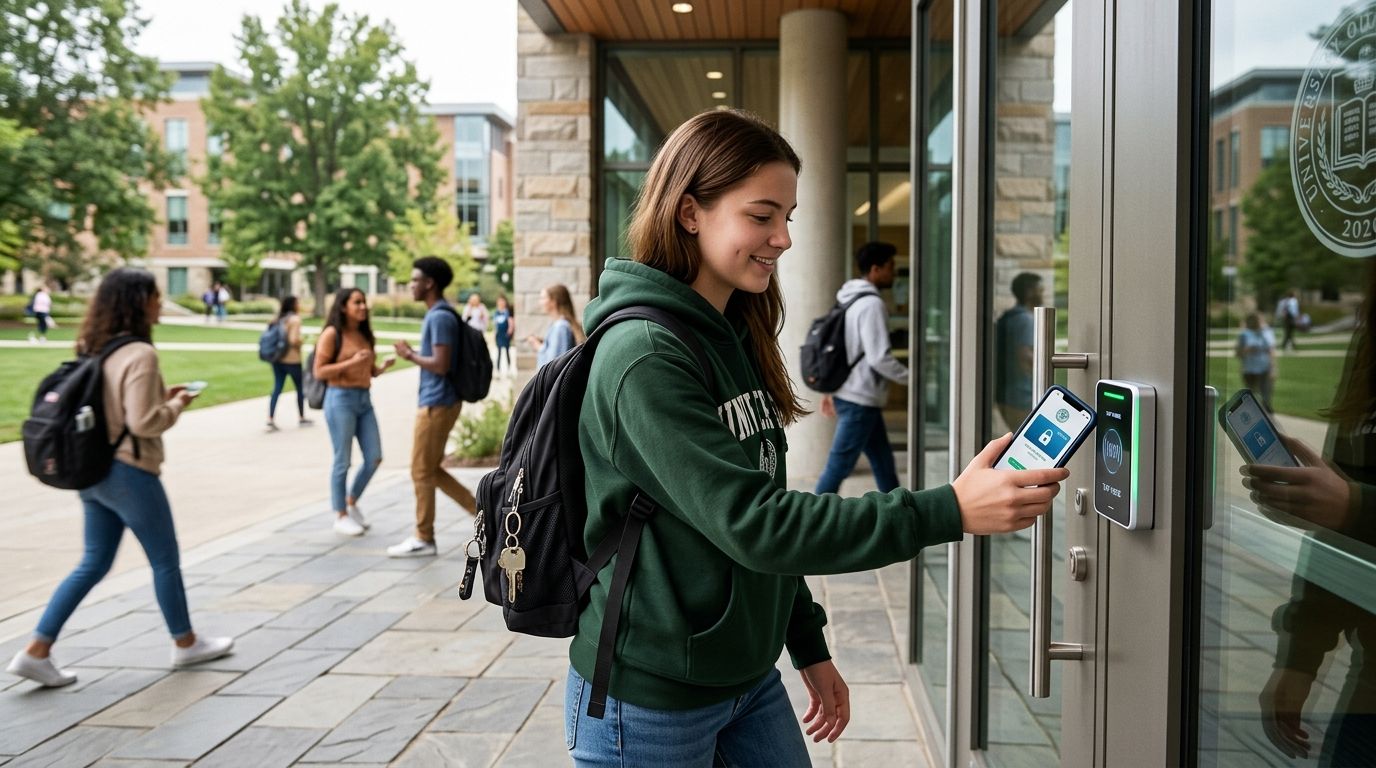
05 Sep Best Mobile Credential Access Control for Universities 2026
Universities juggle thousands of doors, tens of thousands of students who lose their phones as often as their ID cards, and a facilities team that can't afford a lockout at 2 a.m. HID Mobile Access wins overall for 2026, Salto Systems wins for residence halls, and Brivo Access wins for smaller colleges without a dedicated security operations team.
- HID Mobile Access is the best overall pick for best mobile credential access control systems for universities in 2026 thanks to broad reader compatibility.
- Salto Systems wins for residence halls where wireless locks matter more than centralized cloud dashboards.
- CBORD/Transact stays the strongest choice when a campus already runs its dining and laundry through a one-card system.
- Avigilon Alta Access (formerly Openpath) fits multi-building campuses that need one dashboard for every entrance.
- Brivo Access is the budget-friendly cloud option for smaller colleges running access control without a large IT staff.
Why this matters
A lost physical ID card sits in a drawer until someone reports it. A lost phone gets locked, wiped, or reported within minutes, which is the entire argument for mobile credentials on campus. Universities that switch from mag-stripe or basic prox cards to Bluetooth and NFC-based mobile credentials cut down on the reissue lines that clog every housing office during move-in week.
The harder problem is that a campus isn't one building, it's dozens of buildings built across different decades, each with its own door hardware and wiring. Picking the wrong platform means ripping out readers again in three years. That's exactly where a proper access control systems for university campuses plan pays for itself before the first semester ends.
What makes the best mobile credential access control system for universities
- Reader compatibility with existing hardware so the whole campus doesn't need a rip-and-replace
- Bluetooth and NFC support for both iPhone and Android wallets, not one or the other
- Instant credential revocation when a student reports a lost phone
- Integration with student ID systems for dining, laundry, and library access
- Cloud management so campus safety can lock down a building remotely during an incident
- Scalability across residence halls, academic buildings, and parking structures without licensing headaches
Mobile credential access control systems for universities at a glance
| System | Best for | Standout feature | Key limitation |
|---|---|---|---|
| HID Mobile Access | Standardizing on existing card readers | Works with HID's installed reader base already on most campuses | Best value comes from staying in the HID hardware ecosystem |
| CBORD/Transact | One-card campus ecosystems | Ties door access to dining, laundry, and library in one credential | Primarily built around the campus card model, not standalone security |
| Salto Systems | Residence hall wireless locks | Battery-powered wireless locks that don't need new wiring per door | Wireless locks report less frequently than hard-wired readers |
| Avigilon Alta Access | Multi-building cloud management | Single cloud dashboard across every building on campus | Full value depends on replacing legacy door controllers |
| Genetec Synergis | Large research universities | Deep integration with video surveillance and identity systems | Requires a dedicated IT/security team to run well |
| Brivo Access | Smaller colleges with lean IT teams | Cloud subscription model with minimal on-site server hardware | Fewer deep integrations than enterprise-grade platforms |
1. HID Mobile Access: best mobile credential access control system for universities standardizing on existing readers
HID Mobile Access runs on HID's Seos credential technology and works through a mobile app that pushes Bluetooth and NFC credentials to a student's phone. Most campuses built in the last two decades already have HID readers installed somewhere, which makes this the lowest-friction upgrade path for a university trying to modernize without tearing out every door controller.
HID Mobile Access pros:
- Works with a huge installed base of existing HID readers
- Supports both Bluetooth long-range and tap-to-unlock NFC
- Established vendor with a long track record in higher ed
HID Mobile Access cons:
- Older non-HID readers on campus still need replacement
- Full mobile rollout works best alongside a hardware refresh plan
Best for: universities with HID readers already installed who want mobile credentials without a full hardware overhaul. Verdict: Buy.
2. CBORD/Transact: best mobile credential access control system for universities running one-card ecosystems
CBORD (now under Transact) built its name on the campus one-card model, where a single credential opens dorm doors and also pays for a meal plan or a load of laundry. For campuses that already run dining services through this platform, extending the same credential to mobile makes day-to-day life simpler for students juggling one phone instead of three plastic cards.
CBORD/Transact pros:
- Single credential covers dining, laundry, library, and door access
- Deep roots in higher ed with widespread campus adoption
- Reduces the number of separate systems facilities has to manage
CBORD/Transact cons:
- Built around the one-card model first, security second
- Switching away later means untangling access control from meal plans and payments
Best for: campuses that already run dining and student services through a one-card system. Verdict: Buy.
3. Salto Systems: best mobile credential access control system for university residence halls
Salto's wireless locks are battery-powered and don't require pulling new wire to every dorm room door, which matters when a housing department needs to secure 400 rooms without an electrician at each frame. The mobile credential unlocks the door directly from the student's phone over Bluetooth, and the locks report status back to a central system on a schedule rather than in real time.
Salto Systems pros:
- No new wiring needed at each dorm room door
- Battery-powered locks cut installation cost per room
- Mobile credentials work well for high-turnover dorm assignments each fall
Salto Systems cons:
- Wireless locks check in less frequently than hard-wired readers
- Battery management becomes an ongoing maintenance task across hundreds of rooms
Best for: residence halls where wiring every door isn't practical. Verdict: Buy.
4. Avigilon Alta Access (formerly Openpath): best mobile credential access control system for multi-building campus management
Avigilon Alta Access is cloud-native from the ground up, built around a mobile-first credential model rather than a legacy card system with mobile bolted on later. A campus with academic buildings, admin offices, and athletic facilities spread across a large footprint gets one dashboard that shows door status everywhere at once.
Avigilon Alta Access pros:
- Cloud dashboard covers every building from one login
- Mobile credentialing is the primary design, not an add-on feature
- Remote lockdown capability across multiple buildings at once
Avigilon Alta Access cons:
- Best results come from replacing older door controllers, which adds cost
- Newer to higher ed than legacy campus card vendors
Best for: campuses spread across many buildings that need centralized control. Verdict: Buy.
5. Genetec Synergis: best mobile credential access control system for large research universities
Genetec Synergis is built for scale and pairs tightly with Genetec's video surveillance platform, which matters for a research university running its own security operations center around the clock. It handles mobile credentials alongside badge printing, visitor management, and camera integration in one unified system.
Genetec Synergis pros:
- Tight integration between access control and video surveillance
- Built to handle enterprise-scale door and camera counts
- Strong audit trail features for compliance-heavy research campuses
Genetec Synergis cons:
- Requires a dedicated IT or security team to administer well
- Overkill for a small college running a handful of buildings
Best for: large research universities with an in-house security operations team. Verdict: Buy.
6. Brivo Access: best mobile credential access control system for smaller colleges with lean IT teams
Brivo runs entirely in the cloud, which means a smaller college doesn't need a server room dedicated to access control hardware. Mobile credentials, visitor logs, and door schedules all live in a web dashboard that a two-person facilities team can manage without specialized training.
Brivo Access pros:
- Cloud subscription model with minimal on-site hardware
- Simple enough for a small facilities team to run without a dedicated security IT hire
- Fast to deploy compared to enterprise platforms
Brivo Access cons:
- Fewer deep integrations than Genetec or CBORD offer
- Advanced reporting features lag behind enterprise-tier competitors
Best for: smaller colleges without a large in-house IT or security department. Verdict: Buy.
How we ranked these systems
Each system was measured against the six criteria above: reader compatibility, Bluetooth/NFC support, revocation speed, student ID integration, cloud management, and scalability across a campus footprint. HID and CBORD lead because most campuses already run some version of their hardware or card ecosystem. Salto leads for dorms specifically because wireless locks solve the wiring problem that campus housing departments hit every time. Genetec and Avigilon Alta earn their spots on scale and cloud-first design, while Brivo earns its spot on simplicity for smaller schools.
“If a mobile credential system can’t revoke a lost phone in under a minute, it isn’t ready for a residence hall.”
Which mobile credential access control system should your university choose?
A campus already running HID readers should stay in that ecosystem and add mobile on top of it rather than replatforming everything at once. A campus building new dorms or retrofitting old ones without wiring budget should look at Salto first. A research university running its own security operations center around the clock belongs on Genetec Synergis. Everyone else without a large IT team should start with Brivo and grow into a bigger platform later if the campus expands.
Deciding between systems is easier with a walkthrough of how to choose an access control system built around door count, hardware age, and staffing before signing a contract for 2026.
DBSI has spent over 15 years of professional experience installing and supporting access control, network cabling, and security systems for New Jersey businesses and campuses, and the same crew that pulls Cat6a for a new academic building can wire the door hardware to go with it. The goal on any campus project is the same one DBSI applies to every client: keep the buildings running and the doors secure 24/7.
Plan your campus access control upgrade
Get a walkthrough of your current door hardware before choosing a mobile credential system.
FAQ
What is the best mobile credential access control system for universities in 2026?
HID Mobile Access is the strongest overall pick for 2026 because it works with the reader hardware most campuses already have installed. Salto Systems wins specifically for residence halls, and Brivo Access wins for smaller colleges with lean IT staff.
Is mobile credential access control better than physical ID cards for universities?
Mobile credentials get revoked in minutes when a phone is lost, while a physical card sits unreported for hours or days. Most universities in 2026 run both side by side during a transition period rather than dropping cards entirely.
Does CBORD/Transact work for door access or just dining and payments?
CBORD/Transact covers door access alongside dining, laundry, and library systems through one campus credential. It’s built primarily around the one-card model, so campuses wanting deep video integration should also look at Genetec Synergis.
Can existing HID readers support mobile credentials without replacement?
Many existing HID readers already support Bluetooth and NFC mobile credentials through HID Mobile Access without a full hardware swap. Older non-HID readers on the same campus usually still need replacement.
Why do residence halls use wireless locks instead of standard access control readers?
Wireless locks like Salto’s don’t require running new wiring to every dorm room door, which cuts installation cost across hundreds of rooms. The tradeoff is that wireless locks check in less frequently than hard-wired readers.
How much IT staff does a university need to run cloud-based access control?
Cloud platforms like Brivo Access are built for a two-person facilities team without a dedicated security IT hire. Enterprise platforms like Genetec Synergis assume a full security operations center running 24/7.
What should a university check before switching mobile credential vendors?
Start with an inventory of existing door readers, wiring age, and which buildings already integrate with dining or library systems. That audit determines whether a hardware refresh is needed before mobile credentials go live in 2026.
One last thing
The biggest mistake campuses make isn't picking the wrong mobile credential vendor, it's skipping the door-by-door hardware audit first. A dorm built in the 1970s and an academic building built in 2015 often need two different install approaches even under the same platform, and finding that out mid-project costs more than finding it out before signing a contract.
Related guides
- Onboarding new employees with access control credentials
- Network cabling providers for universities and college campuses
Sorry, the comment form is closed at this time.