
20 Sep Can a VoIP Phone Work During an Outage? 2026 Verdict
A standard VoIP phone system goes dead the instant your internet connection drops, unless you've already built in a way to reroute calls before that happens. In 2026, the fix isn't complicated, but most small businesses in New Jersey don't have it configured until after they've missed a week of calls during an outage.
- A standard VoIP phone system stops working the moment your internet connection drops, and that hasn’t changed in 2026.
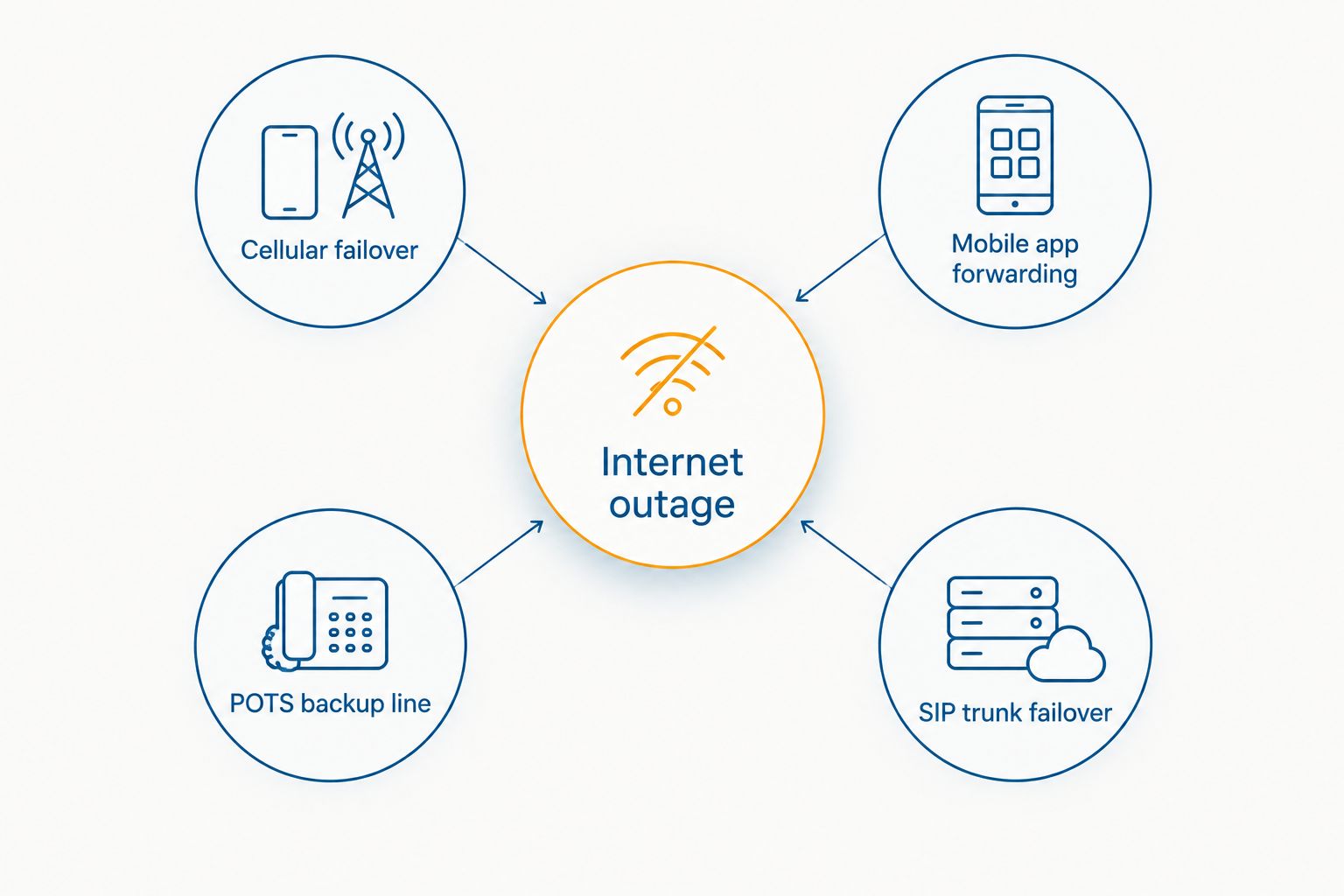
- Cellular failover, mobile app forwarding, or a backup analog line keep a business phone system reachable when the main circuit goes down.
- Power outages take out VoIP phones too, since desk phones and routers run on network power, not a dedicated phone line.
- A single internet circuit with no failover is the single biggest point of failure in most small business phone setups.
Why this matters
A missed call during a two-hour outage isn't an inconvenience, it's lost revenue and a customer who called your competitor next. Businesses running on VoIP alone, with no backup path, go completely silent the moment the ISP circuit drops. That's the tradeoff VoIP made when it moved calling off the old copper network and onto your internet connection.
The good news: business internet failover and backup setups solve this cleanly, and they don't require ripping out your existing phone system. They just need to be planned before the outage, not during it.
Does a VoIP phone system work during an internet outage?
No, not without a backup path already in place. A VoIP phone system routes every call over your internet connection, so when that connection goes down, the phones go silent at the same moment. The way around it is a failover method that reroutes calls automatically or manually to a working connection.
| Failover method | What happens without internet | Best for |
|---|---|---|
| No failover configured | Phones go completely silent, calls fail to connect | Not recommended for any business |
| Cellular (4G/5G) backup circuit | Router switches to a cellular connection and phones stay live | Businesses that can't tolerate dropped calls |
| Mobile app call forwarding | Calls forward to a staff member's cell phone through the provider's app | Small offices with one or two lines |
| Analog POTS backup line | A traditional copper line keeps a main number ringing | Locations with spotty or single-provider internet |
| SIP trunk failover to a second carrier | Calls route automatically to a backup carrier | Multi-location businesses |
Cellular failover: keeps the line live when your ISP goes down
A cellular failover router sits behind your main internet circuit and switches your phone system's traffic to a 4G or 5G connection the moment it detects the primary line is down. Calls keep routing without anyone touching a phone. Verdict: Buy for any business that can't afford a silent phone line, even for an hour.
The catch: cellular failover only works if the failover router itself has power. Pair it with a UPS if your building loses power along with internet during storms, which is the more common outage scenario in New Jersey.
Mobile app forwarding: the fastest fix for a one- or two-line office
Most hosted VoIP platforms include a mobile app that can forward incoming calls to a cell phone number when the office connection is unreachable. It's manual in most setups, meaning someone has to flip the setting, but it's free with most business phone system plans and takes under a minute to activate. Verdict: Buy for small offices as a baseline, but don't rely on it as your only plan.
The downside is obvious: if the person responsible for flipping that switch is unreachable, the office goes dark anyway.
Analog POTS backup line: the old-school fallback that still works
A plain old telephone service line runs on the phone company's own power from its central office, which is why old landlines kept working through local power outages long before VoIP existed. Keeping one active line as a backup, tied to your main number through call forwarding, gives you a path that doesn't depend on your internet or your building's power at all. Verdict: Hold — worth it for businesses in areas with unreliable internet, otherwise the monthly cost of a line you rarely use outweighs the benefit.
SIP trunk failover: automatic rerouting for multi-location businesses
Businesses running VoIP across more than one office can configure SIP trunk failover so that if one location's internet goes down, calls route through a working circuit at another site or through a backup carrier automatically. No one has to notice the outage for it to work. Verdict: Buy for any business with more than one physical location and shared call volume.
Why VoIP goes down when the internet does
- The router or modem loses its uplink, and every active SIP call drops instantly, not gradually.
- A local power failure disables switches, routers, and desk phones unless everything critical sits on a UPS.
- A single ISP circuit with no second path means one outage takes every line down at once.
- Cloud-hosted VoIP servers can't reach on-site phones if the building itself has no working internet path, even if the cloud platform is running fine.
- Router firmware misconfigured for failover can silently fail to trigger the backup connection when it's actually needed.
- Desk phones powered over Ethernet (PoE) go dark the moment the switch loses power, even if the internet itself is still up.
Build failover into your phone system
DBSI designs backup internet and cellular failover for New Jersey business phone systems.
A written IT disaster recovery plan is where most businesses catch this gap before it costs them a customer, because it forces someone to answer "what happens to our phones if the internet goes down" before it actually does. If you're evaluating providers from scratch, it's also worth reviewing how to choose a VoIP phone system provider with failover options built in rather than bolted on later.
Does a cordless VoIP phone still work if the power goes out?
No, a cordless VoIP phone stops working the moment the power goes out, because it depends on a base station and router that run on electrical power, not a phone line. Traditional corded landlines survived local power outages because the phone company's central office powered the line remotely; VoIP phones don't have that path unless the router, switch, and base station are all sitting on a UPS.
Can I make emergency calls if my VoIP internet is down?
No, standard VoIP calling, including 911, stops working the moment your internet connection drops unless a failover path is active. This is the single strongest argument for cellular failover or a backup POTS line: it's not just about missed sales calls, it's about being reachable for an emergency during the outage itself.
Is a landline more reliable than VoIP during an outage?
Yes, a traditional landline is more reliable than standalone VoIP during a local power outage, because it runs on power from the phone company's central office rather than your building's electricity. That reliability gap is exactly why many businesses keep one analog line active as a backup even after switching most lines to VoIP.
FAQ
Can a VoIP phone system work during an internet outage?
Not without a backup path already configured. VoIP calls route over your internet connection, so a standard setup goes silent the moment that connection drops, which is why cellular failover or a backup analog line matters.
Does VoIP work if the power goes out but the internet is fine?
No, if your router, switch, or desk phones lose power, VoIP calling stops even if the internet connection itself is technically still up elsewhere. A UPS on your core network gear closes this gap.
What is the best backup option for a VoIP outage?
Cellular failover is the best backup for most businesses in 2026 because it switches automatically without anyone flipping a setting, unlike mobile app forwarding which requires a manual step.
Is a POTS line worth keeping as a VoIP backup?
A POTS line is worth keeping if your area has unreliable internet, since it runs on the phone company’s own power and doesn’t depend on your building’s electricity or internet at all.
How fast does cellular failover switch over during an outage?
A properly configured cellular failover router detects the primary connection is down and reroutes traffic automatically, without a manual step from staff, though exact switchover behavior depends on the router’s configuration.
Can multiple office locations share failover for VoIP?
Yes, SIP trunk failover lets a multi-location business route calls through a working site or a backup carrier automatically when one location’s internet goes down.
Do I need a UPS for my VoIP phones?
Yes, a UPS on your router, switch, and PoE-powered desk phones is what keeps a VoIP phone system running through a short power outage, since none of that equipment has its own backup power otherwise.
One last thing
The part businesses miss most isn't the internet circuit, it's the PoE switch powering the desk phones themselves. A business can have a fully redundant internet connection and cellular failover in place and still lose every phone in the building the moment the power flickers, because the switch feeding those phones has no battery backup of its own. If you're planning failover for 2026, put the switch and router on the UPS first; the internet backup only matters if the phones themselves still have power to use it.
Related guides
- How to reduce phone system downtime for a growing business
- Business continuity solutions for professional firms
Sorry, the comment form is closed at this time.