

22 Sep Can Security Camera Footage Be Legal Evidence? (2026)
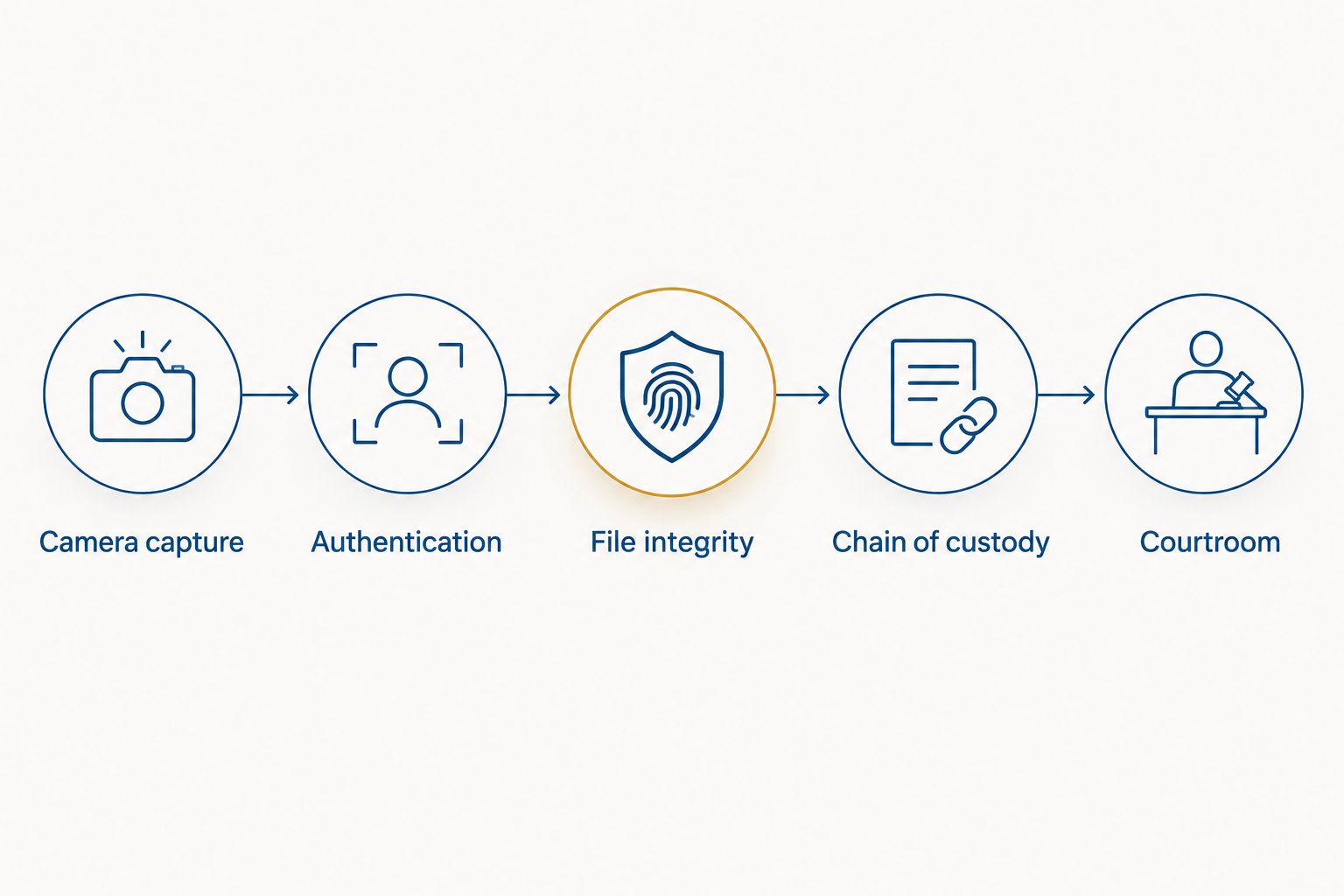
Security camera footage can be used as legal evidence in court, in both criminal and civil cases, provided it clears three tests: the camera system is authenticated, the video file hasn't been altered, and the chain of custody is documented from the moment it's captured to the moment it reaches a courtroom. Judges admit surveillance video routinely in 2026, from retail theft prosecutions to slip-and-fall lawsuits. The part most business owners miss: footage already overwritten by the system's storage cycle before a subpoena or preservation request arrives can't be produced, no matter how clear the incident looked in real time.
- Security camera footage can be used as legal evidence when authentication, an unaltered file, and a documented chain of custody are all in place.
- Courts reject footage far more often for broken chain of custody than for poor picture quality.
- Footage lost to a routine overwrite cycle before a subpoena arrives cannot be produced later, even if it existed for weeks.
- A retention and export policy matters more in 2026 than camera resolution when litigation is on the table.
Why this matters
Most businesses install cameras to deter theft and monitor staff, not to think about courtroom rules. That changes fast the moment a customer files a slip-and-fall claim, a break-in leads to prosecution, or an insurer disputes a liability claim and asks for the tape.
New Jersey courts, like most U.S. jurisdictions, treat surveillance video as demonstrative or documentary evidence, admissible when a witness or system log can establish it's an accurate, unaltered record of what happened. That's a legal standard, not a technical one. A camera with clear 4K footage produces evidence a judge throws out just as fast as a grainy analog feed, if nobody can prove who handled the file between the incident and the hearing.
Audio adds another layer. Whether a business camera can legally record audio in New Jersey depends on separate consent rules that don't apply to video, and getting that wrong can get the audio track excluded even when the video stays in.
Can security camera footage be used as legal evidence?
Yes, with conditions. The table below is what separates footage a court accepts from footage a court throws out.
| Factor | Makes footage admissible | Makes footage inadmissible |
|---|---|---|
| Chain of custody | Documented handoff from camera to storage to the legal team, with names and dates | No record of who accessed, copied, or exported the file |
| Authentication | Timestamp, camera ID, and system logs match the reported incident | No way to confirm the clip came from that camera on that date |
| File integrity | Original export preserved, unedited, in its native format | Clipped, re-compressed, or cropped with metadata stripped out |
| Retention | Footage exported and preserved before the system overwrites it | Footage lost to a routine overwrite cycle before a subpoena arrives |
| Access control | Limited, logged staff access to the storage system or NVR | Broad, unlogged access that leaves tampering impossible to rule out |
A business that can check every box in the left column has footage a court will typically weigh alongside witness testimony. Miss two or three, and opposing counsel has an opening to get the video excluded before a jury ever sees it.
“Courts reject footage over a broken chain of custody far more often than over picture quality.”
Why footage sometimes gets thrown out
Admissibility isn't one rule, it's a stack of smaller ones. The factors that decide whether a specific clip holds up in a New Jersey courtroom in 2026 include:
- Retention window — many DVR and NVR systems overwrite older footage automatically, and a clip that existed on day one can be gone by the time a lawyer requests it.
- Who exported the file — a raw export pulled by an IT technician with a documented process carries more weight than a phone video of a monitor screen.
- System clock accuracy — a camera with a drifted or unset timestamp makes it harder to tie the footage to the exact time of the incident.
- Audio capture — video with unauthorized audio can get the audio portion excluded, or complicate the whole exhibit.
- Storage location — footage held on a cloud platform with access logs is easier to authenticate than a local drive anyone in the office could touch.
- Staff training — employees who don't know how to respond to a preservation letter sometimes let a relevant clip get overwritten before anyone flags it.
Businesses that build a documented process for how to store and manage security camera footage for compliance close most of these gaps before a lawsuit ever gets filed, not after.
Related questions
Does security camera footage need audio to be admissible?
No, video alone is commonly admitted without audio, and many businesses run cameras with audio disabled specifically to avoid consent issues. Audio adds evidentiary value in some cases, but it also adds a separate legal test that video alone doesn't face.
How long should a business keep security footage for legal purposes?
There's no single number that fits every business or every claim type; the right retention window depends on the type of incident, the applicable statute of limitations, and industry-specific compliance rules. The practical failure point in 2026 isn't a short retention window on paper, it's a business that never exports footage before the system's default cycle deletes it.
Can police or insurers request footage without a subpoena?
A business can voluntarily hand over footage to police or an insurer without a subpoena, and many do. A subpoena becomes necessary when the business declines to provide it voluntarily or when a third party in litigation needs to compel production through the court.
Build a footage retention plan that holds up
Camera systems and storage set up for compliance, not just monitoring.
FAQ
Can security camera footage be used as legal evidence in 2026?
Yes, security camera footage can be used as legal evidence in 2026 when it’s authenticated, unaltered, and backed by a documented chain of custody. Courts weigh video alongside other evidence rather than treating it as automatically conclusive.
What makes security camera footage inadmissible in court?
Footage becomes inadmissible when nobody can prove who handled the file, when the original was edited or re-compressed, or when the timestamp doesn’t match the reported incident. Broken chain of custody is the most common reason courts exclude video evidence.
Do businesses need a subpoena to release security footage?
No, a business can release footage voluntarily to police or an insurer without a subpoena. A subpoena is only required when the business refuses to hand over the footage on its own.
Can security cameras legally record audio in New Jersey?
New Jersey has separate consent rules for audio recording that don’t apply to video alone, and getting audio capture wrong can get that portion of the recording excluded from evidence. Check the specifics before enabling audio on a commercial system.
How does chain of custody work for surveillance footage?
Chain of custody means every person who accessed, copied, or exported the footage is documented by name and date, from the moment it’s pulled off the camera to the moment it’s handed to legal counsel. A gap in that record is the single fastest way a court excludes an otherwise clear video.
Does footage need to be in its original file format to be used as evidence?
Courts favor the original, unedited export over a clipped or re-compressed copy because the native file preserves metadata that helps authenticate it. A cropped clip or a phone recording of a monitor screen is harder to authenticate than a direct system export.
Can footage be thrown out even if it clearly shows what happened?
Yes, a court can exclude footage that clearly shows an incident if the chain of custody is broken or the file’s authenticity can’t be established. Picture quality doesn’t overcome a procedural gap in how the footage was handled.
One last thing
The clip that loses a case isn't usually blurry or missing the incident, it's the clip nobody exported in time. A camera system that overwrites on a fixed cycle doesn't care that a customer is threatening a lawsuit three weeks after a fall; by the time legal counsel asks for footage, the default cycle has already erased it. The fix isn't a better camera, it's a written process for who exports footage, how it's stored, and who signs off when a preservation request comes in.
Related guides
- Camera placement for a commercial security system
- Back up security camera footage to the cloud automatically
- PoE security cameras for small business offices
Sorry, the comment form is closed at this time.