

22 Sep Can Structured Cabling Be Installed Without Disruption? 2026
Structured cabling installation doesn't require shutting an office down. Cable runs, patch panels, and jack terminations get scheduled zone by zone, after hours, or over a weekend so staff keep working while the wiring underneath the floor gets rebuilt. The one caveat: a short cutover window when specific jacks or the phone system switch to the new lines, which is minutes of disruption, not days.
- Structured cabling can be installed without disrupting an office by phasing work zone by zone during business hours in 2026.
- After-hours and weekend scheduling keeps daytime staff untouched while cable runs go in above the ceiling.
- Existing phone and network lines usually stay live until a short, planned cutover swaps them to the new cabling.
- Multi-floor or multi-tenant buildings need more coordination but not more downtime per zone.
- DBSI plans structured cabling projects around a working office for small and mid-sized businesses in the Fairfield, NJ area.
Why this matters
Most businesses delay a cabling upgrade because they picture a construction crew tearing open walls for a week. That's not how a properly planned job runs in 2026. The bulk of a structured cabling installation happens above drop ceilings, inside existing conduit, and in the wiring closet — spaces nobody at a desk ever sees.
The risk isn't the cable pull itself. It's a rushed office relocation or build-out where cabling gets crammed into the same week as furniture delivery and desk moves. Separate the cabling timeline from the move timeline and the disruption drops close to zero.
Can structured cabling be installed without disrupting your office?
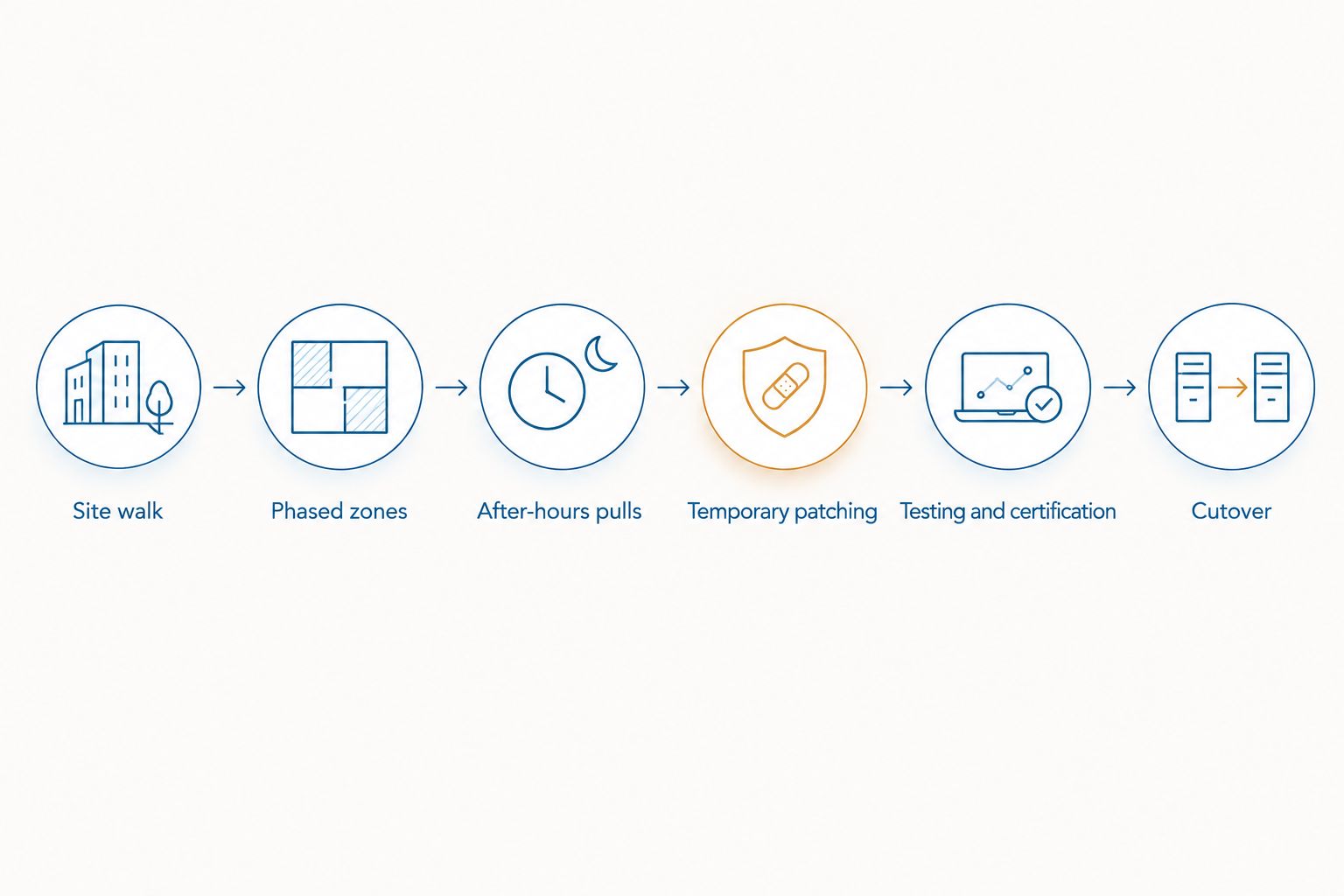
Yes, and the sequence that keeps disruption low looks the same whether it's a five-person office or a full floor:
- Site walk and cable path mapping — the installer identifies ceiling access, existing conduit, and where new drops need to land before anyone touches a tool.
- Phased zone installation — one section of the office gets cabled while the rest of the staff works normally in another area.
- After-hours or weekend pulls — runs through occupied work areas get scheduled outside business hours; runs through empty closets or storage happen anytime.
- Temporary patching — existing phone and data jacks stay active on the old cabling until the new runs are terminated and tested.
- Testing and certification — every new run gets verified for continuity and speed before it goes live, catching problems before cutover instead of after.
- Cutover — jacks switch from old cabling to new, one zone at a time, in a window measured in minutes per drop, not hours per floor.
That sequence is standard for a single office suite. It scales the same way when cabling has to run across multiple floors — each floor becomes its own phase instead of one continuous shutdown.
Why disruption varies from office to office
Some offices barely notice the crew. Others feel every day of it. The difference usually comes down to a handful of factors:
- Ceiling and wall type — drop ceilings and accessible conduit mean cable goes in fast with no drywall work; solid walls and finished ceilings slow everything down.
- Number of floors involved — a single-floor office finishes in one continuous phase; a multi-floor building needs a phase per floor.
- Condition of the existing cabling — if old Cat5 has to come out alongside the new runs, that adds a demolition step the install itself doesn't have.
- Open floor plan vs. private offices — open layouts let a crew work a whole zone at once; private offices mean more start-and-stop scheduling.
- Timing flexibility — a business that allows weekend or evening access finishes with almost zero visible disruption; one that only allows daytime access stretches the same job over more calendar days.
- Building ownership — multi-tenant buildings add a coordination step with property management before any ceiling tile comes down.
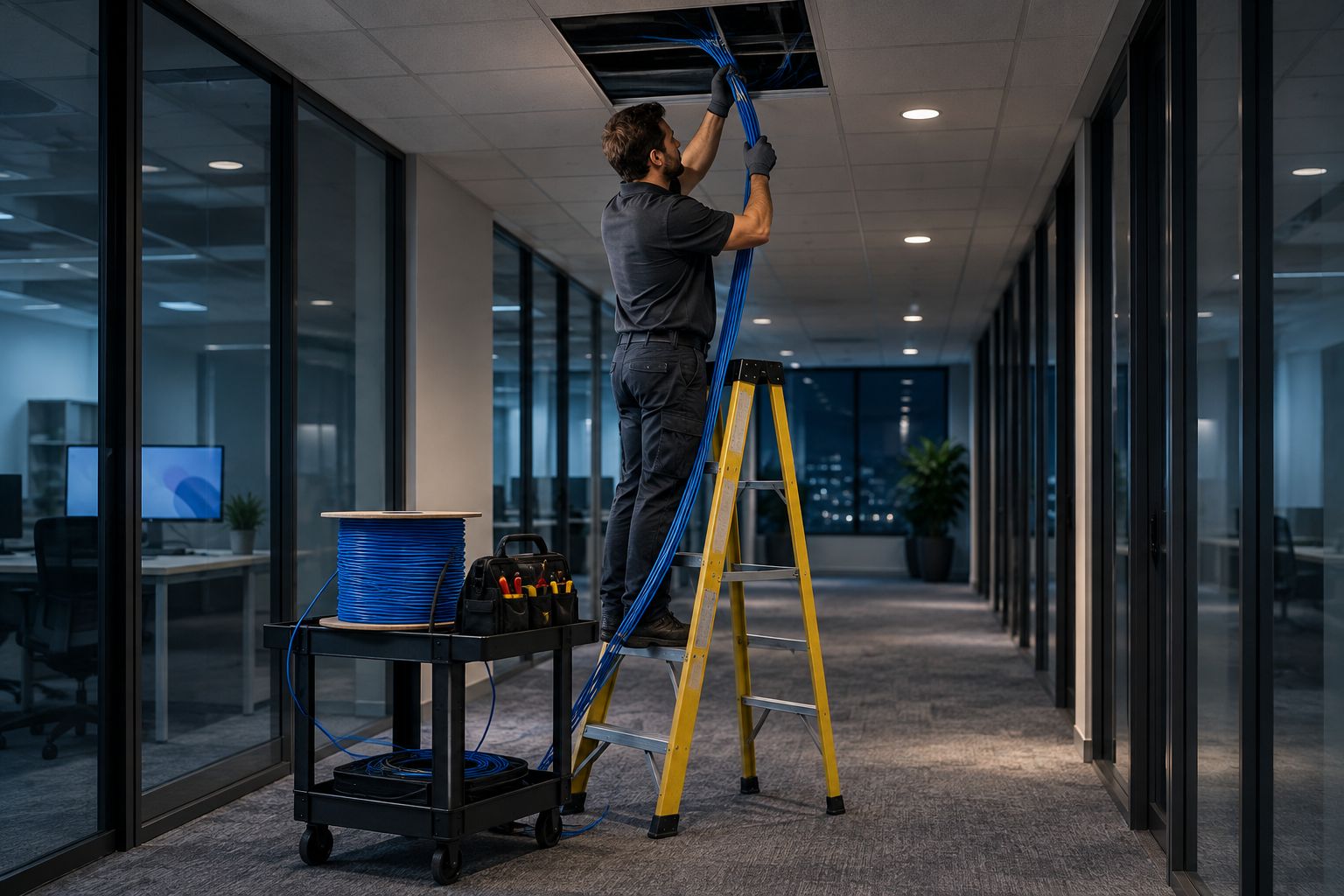
A phased approach through an occupied office in 2026 looks like this in practice: a technician works above the ceiling tiles in one wing while the rest of the staff keeps typing at their desks a few feet below.
How long does structured cabling installation take in an office?
Timeline depends on the number of drops, the number of floors, and how much access the crew gets outside business hours. Phasing the work stretches the calendar, not the disruption — a job spread over three weekends produces the same low-impact result as a job compressed into three straight days with full building access.
Does the network go down during a structured cabling install?
The existing network and phone lines typically stay live on the old cabling throughout the project. The only interruption is the cutover itself, when a jack switches from old wiring to new — a per-drop event, not a building-wide outage.
Can cabling be run without opening walls?
Most commercial cabling runs through drop ceilings, existing conduit, and wiring closets rather than inside finished walls. Walls only get opened when there's no other path to a jack location, and even then it's a localized patch, not a full demolition.
Once the new cabling is in and certified, it's worth having the crew test and certify the cabling before cutover rather than after — catching a bad termination before it's live saves a second disruption down the road. DBSI runs structured cabling projects for small and mid-sized offices in the Fairfield, NJ area with that phased, after-hours approach as the default, not the upsell.
Plan a cabling install around your office
Get a phased schedule that keeps staff working during the project.
FAQ
Can structured cabling be installed without disrupting an office?
Yes — phased, after-hours installation keeps an office running while new cabling goes in. Expect a brief cutover window per jack when service switches over, not a building-wide outage.
How long does a structured cabling installation take?
Timeline depends on the number of drops and floors involved. Phasing the work around business hours in 2026 extends the calendar, not the level of disruption staff experience.
Does the network go down during a cabling install?
Existing phone and data lines usually stay live on the old cabling until a planned cutover. That cutover is a per-jack event lasting minutes, not a full outage.
Can cabling be installed without opening walls?
Most runs go through drop ceilings, existing conduit, and wiring closets. Walls only get opened when no other path exists to a specific jack location.
Can cabling be installed while employees are working at their desks?
Yes — zone-by-zone phasing lets a crew work one section of the office while staff in another section continue working normally.
Does a cabling upgrade require shutting off Wi-Fi or phones?
Only briefly, during the final cutover for a given zone. Wi-Fi and phone service on unaffected areas of the office stays untouched.
Is a multi-floor cabling install more disruptive than a single floor?
Not per floor — each floor becomes its own phase, so disruption per area stays the same even though the overall project takes longer.
Should cabling be scheduled separately from an office move?
Yes — running cabling on its own timeline before furniture and desk moves happen keeps both projects from colliding into one disruptive week.
One last thing
The part that actually causes future disruption isn't the install day — it's a poorly labeled patch panel left behind afterward. An office that skips documentation during the project ends up calling someone back in six months just to trace which cable goes where, turning a five-minute fix into another service visit. Ask for labeled, documented runs as part of the original scope, not as an add-on after the fact.
Related guides
- How much does structured cabling installation cost per drop
- Cat6a cabling for high-speed business networks
- How to test and certify structured cabling installations
Sorry, the comment form is closed at this time.