
09 Sep Best Door Access Control Systems for Auto Dealerships 2026
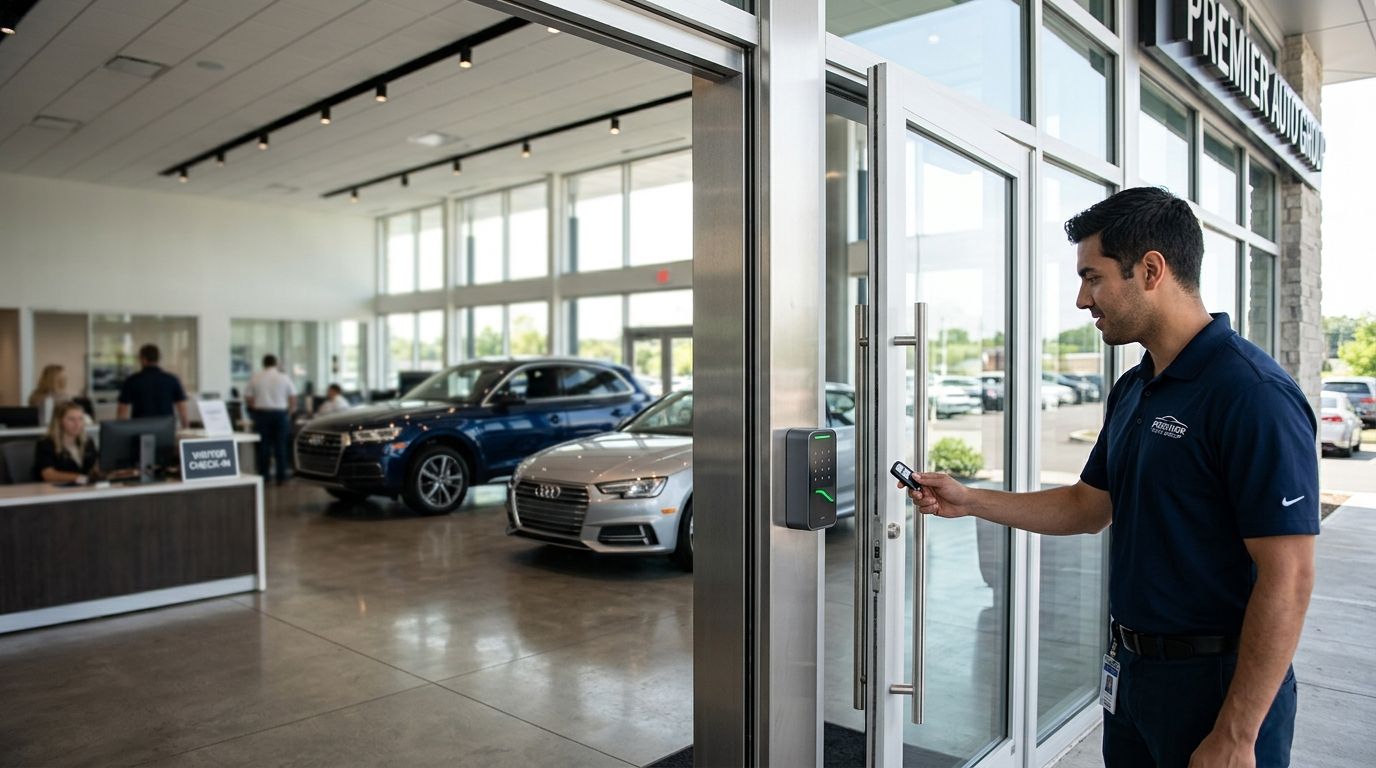
A door access control system for auto dealerships restricts who can open lot entrances, the service bay, the parts counter, and the F&I office, replacing shared keys with individual credentials tied to a schedule. Dealerships run longer and more irregular hours than a typical office — sales floors stay open into the evening, service bays open before sunrise, and lot attendants move vehicles at odd hours — so the access plan has to match shift patterns, not a single 9-to-5 lock schedule.
- A door access control system for auto dealerships needs separate schedules for sales, service, and parts staff, not one blanket rule.
- Cloud-based access control lets a dealership manage multiple entry points and revoke a terminated employee’s credential from a phone in 2026.
- Biometric readers make sense at the parts cage and cash office; keycards or mobile credentials cover the sales floor and staff entrances.
- Pairing access logs with security cameras at every exterior door closes the gap on after-hours test drives and inventory movement.
Why this matters for auto dealerships
A dealership has more unlocked-adjacent risk than most small businesses: vehicle keys, cash drawers, customer financial paperwork, and a lot full of inventory that's meant to be driven. A single shared key to the service bay or parts room means there's no record of who opened it or when, and once a technician or salesperson leaves, that key still works until every lock gets rekeyed.
A door access control system for auto dealerships turns every entry point into a logged event — who came in, through which door, at what time — and it lets a manager cut off access for one person without touching anyone else's credential. That distinction matters more at a dealership than a standard office because turnover among lot attendants and detailers tends to run higher, and the doors being protected lead straight to inventory and cash.
Map every entry point before you buy anything
Start by walking the property and listing every door that separates a controlled area from an open one. A typical dealership has more of these than owners expect once showroom side doors, service bay overhead doors, and parts counter doors get counted alongside the front entrance.
- Front showroom entrance and any staff-only side doors
- Service bay overhead doors and the technician entrance
- Parts department counter door and the back receiving door
- F&I offices and any room holding customer paperwork or cash
- Rooftop, server closet, or key control room doors
Once the list is complete, decide which doors need a badge or fob and which just need a standard lock — not every closet needs an electronic reader.
Set schedule-based rules by department
Sales staff, service technicians, and parts counter employees rarely work the same hours, and a door access control system for auto dealerships should reflect that instead of granting blanket 24-hour access to everyone.
- Give service technicians access starting an hour before the bay opens, not overnight
- Restrict parts counter access to counter staff and the parts manager only
- Set sales floor hours to match posted business hours, with a manager override
- Lock down finance office doors outside of appointment hours
- Build a separate after-hours schedule for detailers who prep vehicles before opening
This is a manual step you can do with almost any access control platform's scheduling tab — no upgrade required, just discipline in setting it up correctly the first time.
Assign credential tiers instead of one shared badge type
A dealership typically needs at least three or four credential tiers: general staff, service techs, management, and vendors or contractors. Handing everyone the same badge with the same permissions defeats the purpose of the system.
- Tier 1: front desk and sales staff — showroom and staff entrance only
- Tier 2: service technicians — bay doors, tool room, technician entrance
- Tier 3: management — every door, including finance and the server closet
- Tier 4: temporary vendor or contractor credentials that expire automatically
This is where a cloud-based access control platform earns its keep — tier changes and expirations happen from a dashboard instead of a physical rekey. Choosing the right starting platform matters more than any single feature, so review how to choose an access control system for your business before locking in a vendor.
Secure the parts room and cash office with the strongest credential
Parts inventory and cash handling areas carry more theft risk than a sales floor, so they deserve a stronger credential than a basic proximity card.
- Use a PIN-plus-card combination or a biometric reader at the parts cage
- Require dual credentials (manager plus staff) for the cash office after closing
- Set an automatic lockout after a fixed number of failed attempts
- Keep a physical key backup in a lockbox only management can open
Integrate access logs with your camera system
An access log tells you a door opened; a camera tells you who actually walked through it. Pairing the two closes the gap that shows up during after-hours test drives, unauthorized lot access, or a disputed inventory discrepancy.
- Place a camera at every exterior door tied to the access control system
- Time-stamp footage against the access log, not just a general DVR timeline
- Review exterior door footage weekly, not only after an incident
- Store footage long enough to cover your insurance carrier's claims window
Dealerships that already run security camera systems for auto dealerships usually find the access control integration is the missing half — cameras record the event, access control controls who caused it.
Choose between cloud-based and on-premise control
A cloud-based system manages credentials, schedules, and revocations from a browser or app, which fits a dealership better than an on-premise server that requires someone on-site to make a change. On-premise systems can cost less upfront but leave the dealership without remote control if a manager is off-site when a badge needs to be shut off immediately.
Plan for after-hours lockdown and holidays
Dealerships close for holidays and run reduced staff on Sundays in many states, so the access schedule needs a separate lockdown mode that isn't just "business hours minus one."
- Build a holiday schedule that overrides the standard weekly one
- Set an automatic full-lockdown time even on business days, for after the last sales appointment
- Test the lockdown mode manually every quarter, not just at setup
Get dealership access control set up right
DBSI has installed access control for auto dealerships across New Jersey for over 15 years.
Comparing access control options for auto dealerships
| Option | Best for | Key limitation |
|---|---|---|
| Keypad/PIN lock | Single back doors, low-traffic storage rooms | No individual audit trail — everyone shares the code |
| Keycard/fob system | Staff entrances, sales floor doors | Lost cards need manual deactivation; cards get shared |
| Mobile credential | Managers and staff who already carry a work phone | Depends on staff phone battery and app compliance |
| Biometric reader | Parts cage, cash office, server closet | Higher setup effort; not ideal for high-traffic doors |
| Cloud-based platform | Multi-door, multi-department dealerships | Requires reliable internet at the site |
The verdict for most dealerships in 2026: a cloud-based platform with mobile credentials for staff and a biometric reader on the parts cage and cash office covers the real risk without over-engineering the showroom doors.
Common mistakes dealerships make with access control
- Sharing one fob among lot attendants instead of issuing individual credentials — this erases the audit trail the system exists to provide
- Never revoking access after a technician or salesperson leaves, leaving old credentials active for months
- Treating the parts room like a showroom door, using the same low-security card reader for both
- Skipping camera integration, so a flagged access event has no matching footage to review
- No lockdown schedule for holidays, leaving full staff access active on days the dealership is closed
FAQ
What’s the best door access control system for auto dealerships in 2026?
A cloud-based platform with mobile or keycard credentials for staff, plus a biometric reader on the parts cage and cash office, covers the risk at most dealerships in 2026 without over-securing low-risk doors.
How many entry points does a typical dealership need to secure?
Most dealerships have at least five controlled entry points once the showroom, service bay, parts counter, back receiving door, and finance office are counted separately.
Can access control integrate with security cameras?
Yes, pairing access logs with camera footage at each exterior door lets a manager confirm who used a credential, not just when the door opened. This closes the gap left by shared credentials or lost badges.
Do I need biometric access for the service bay?
Not usually — a keycard or mobile credential is enough for the service bay itself, since technicians rotate through frequently. Biometric readers are better reserved for the parts cage and cash office, where fewer people need access.
Is cloud-based access control better than on-premise for a dealership?
Cloud-based control is generally the better fit for dealerships because it lets a manager revoke a credential or adjust a schedule remotely, without needing to be on-site at a server.
What happens if a key fob is lost or an employee leaves?
With a cloud-based system, the lost or terminated credential gets deactivated instantly from a dashboard or app, without rekeying any physical locks. With a shared PIN or physical key, the whole code or lock has to be changed.
Can access control track after-hours test drives or lot activity?
Yes, when the access log is tied to exterior door cameras, a manager can match a door-open event to the person and vehicle on camera, which is the main way after-hours activity gets flagged.
Does a small independent dealership need the same setup as a franchise dealership?
The same core structure applies — separate schedules for sales, service, and parts — but a smaller dealership may only need two or three credential tiers instead of four.
One last thing
The door most dealerships forget to lock down is the one between the showroom and the service bay — it's used constantly by staff moving between departments, so it often gets left on the default "all staff" access tier by whoever set up the system. That single door is usually the fastest path from the customer-facing floor to the parts room and technician tool storage, so it deserves its own tier, not a default one.
Related guides
- IT support for auto dealerships
- Keyless entry systems for commercial buildings
- Cloud-based access control systems for business
Sorry, the comment form is closed at this time.