
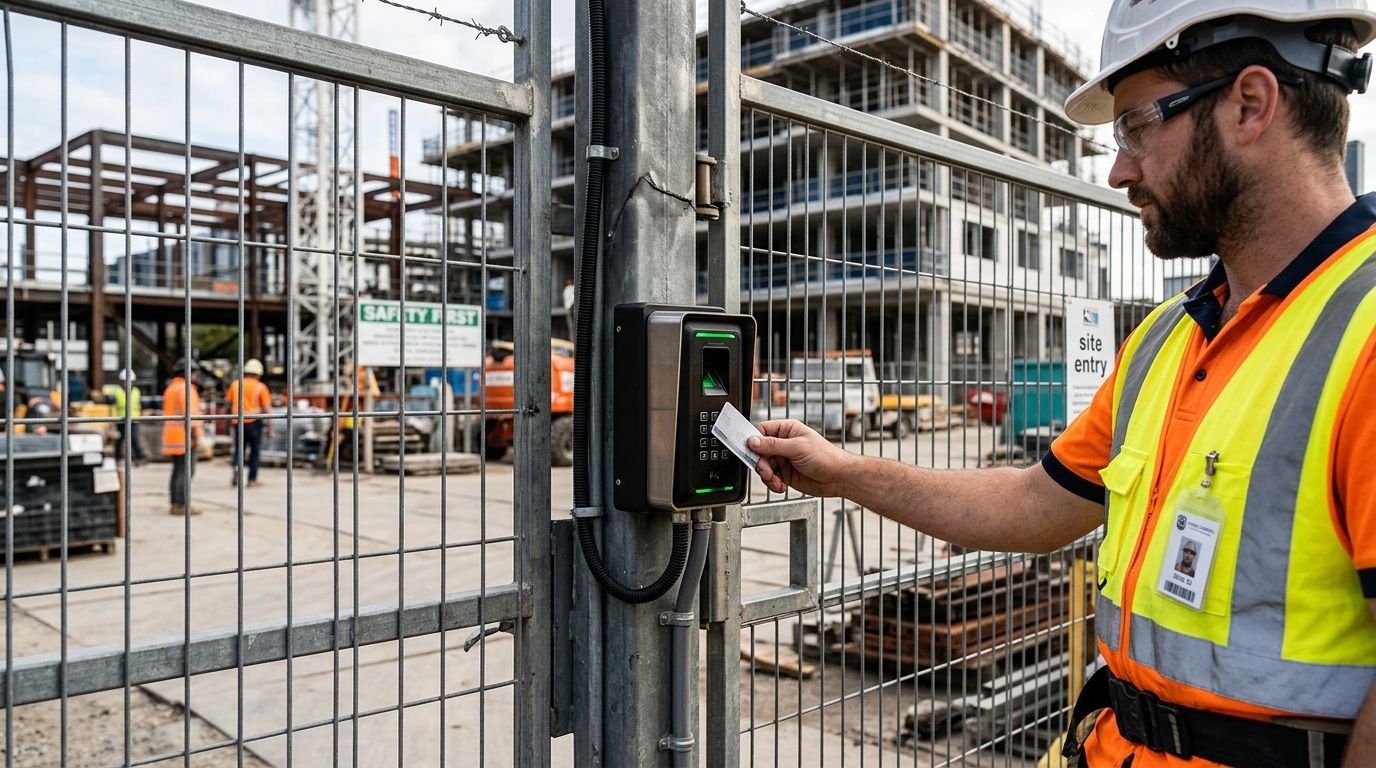
10 Sep Door Access Control for Construction Sites: 2026 Guide
Construction site door access control systems are electronic locking and credential platforms that replace padlocks and shared keys at gates, trailers, and tool cribs, with the goal of cutting theft and proving who was on-site when something goes missing. A jobsite is not an office: crews rotate weekly, power and internet are often temporary, and the same gate might serve dozens of different subcontractors over a six-month build.
- A door access control system for construction sites should run on cellular or solar power, not building electric, since trailers and gates rarely have permanent hookups.
- Mobile credentials beat physical fobs on active jobsites because a superintendent can revoke a departing sub’s access in minutes instead of re-keying a lock.
- DBSI recommends pairing access logs with camera footage at every gate so a disputed entry has both a timestamp and a picture.
- Cloud-managed panels let a general contractor manage several active sites from one dashboard instead of separate systems per location.
- Biometrics belong on a single high-value storage container, never on a busy vehicle gate.
Why door access control matters for construction sites
A commercial build has more entry points than the finished building ever will: perimeter fencing gates, trailer doors, material containers, fuel enclosures, and sometimes a temporary hoist. Every one of those is a place where a shared key or a whiteboard PIN walks off the site with whoever quit last week.
The real difference from a permanent office is turnover speed. A general contractor can onboard and offboard more people in one month on an active site than a small office does in a year, and every unrevoked credential is an open door. If you're comparing this against a standard office setup, how to choose an access control system for your business covers the fundamentals. Construction adds three layers that office guides skip: temporary power, weather exposure, and constantly rotating crews.
Insurance carriers and general contractors increasingly ask for entry logs after a theft claim or a site incident. A system that produces "this gate opened at 6:47 AM under this credential" beats a shared padlock every time a claim gets disputed in 2026.
Map every access point before you order hardware
Walk the site plan before you spec a single reader. Most jobsites need protection at more points than the drawings first suggest, and retrofitting a gate after fencing is up costs more than planning it into the phase schedule.
- Perimeter gates for vehicle and pedestrian entry
- The site trailer or field office door
- Tool crib and material storage containers
- Temporary hoists or material lifts on multi-story builds
- Fuel and generator enclosures on larger sites
- Any access point that relocates as the project phases, such as a gate that moves once framing starts
Choose credentials your subcontractors will actually use
Credential type matters more on a jobsite than in an office because the population using it changes constantly. A system that requires mailing a physical card to every new sub is too slow for a trade that rotates weekly.
- PIN codes for fast, no-hardware access at a gate or trailer, rotated at each phase change
- Mobile credentials pushed to a phone and revoked the same day a sub leaves
- Key fobs for crews without smartphones, still trackable per person
- Biometric readers for one high-value storage area, not the perimeter
- Shared master keys to be phased out entirely, since they cannot be revoked per person
Mobile credentials win for active construction sites in 2026 because a superintendent cuts off one departing worker without re-keying the gate for everyone else. Fobs are the acceptable fallback for crews without company phones.
Solve power and connectivity at the gate first
A controller that depends on the building's permanent electrical panel is the wrong choice for a site where that panel does not exist yet. Handle power and signal before you pick hardware.
- Solar-powered gate controllers for perimeter points with no nearby electric
- Cellular gateways rather than jobsite Wi-Fi, which is usually the last utility installed and the first to fail
- Battery backup rated for at least 24 hours on any controller tied to a trailer door
- Weatherproof outdoor-rated enclosures on every exterior reader
- A written plan for what the gate does when the cellular signal drops
Log every entry against the project schedule
An access log with no context is a list of times. Tie it to the current phase and the day's scheduled trades and it becomes evidence instead of noise.
- Cross-reference gate logs against the daily sub-in schedule
- Flag after-hours entries automatically instead of reviewing them by hand
- Pair door events with camera coverage at construction sites so a disputed entry carries a picture, not just a timestamp
- Export logs weekly, not only after something goes missing
- Keep at least 30 days of history available for insurance and dispute purposes
Set permissions by trade and phase, not by project
Not every sub needs access to every part of the site. An electrician on punch-list work in month five does not need what the excavation crew had in month one.
- Grant access only for the phase a trade is actively working
- Separate material storage credentials from general perimeter credentials
- Give the general contractor's supervisors full-site access and subs restricted access
- Auto-expire each credential on the contract end date instead of relying on memory
- Re-review the whole credential list at every phase handoff
Build a daily audit into the superintendent's routine
The system only works if a human looks at it. A five-minute morning check catches problems before they become a police report.
- Review overnight entries before the crew arrives
- Confirm every active credential still belongs to someone currently on-site
- Spot-check that gate hardware was not propped open overnight
- Note any credential used outside its assigned hours
“If a credential cannot be revoked in under five minutes, it was not built for a jobsite.”
Plan for teardown and reuse before the project ends
Jobsite access control has a lifespan the building does not. The hardware comes down, gets wiped, and often moves to the next project. Plan that at kickoff, not at closeout.
- Confirm at the start whether gate hardware is owned or leased
- Wipe all credentials before any controller is redeployed
- Document which units are solar or cellular versus hardwired to speed the next install
- Hand a clean final access log to the general contractor and the property owner
Get a jobsite access plan for 2026
DBSI designs and installs access control and cameras for active construction sites in New Jersey.
Comparison: access control options for construction sites
| Option | Best for | Key limitation |
|---|---|---|
| PIN keypad | Fast setup at a single gate | Codes get shared across the crew |
| Key fob | Crews without smartphones | Lost fobs need physical replacement |
| Keyless entry with mobile credentials | Sites with weekly sub turnover | Requires a smartphone per worker |
| Biometric reader | One high-value storage container | Too slow for a busy vehicle gate |
| Cloud-managed panel | Multi-site general contractors | Needs cellular signal at every location |
For a contractor running one active site in 2026, a solar-powered mobile credential system at the perimeter gate is the strongest starting point. Add a biometric reader for a single storage container only, never along the full fence line.
Common mistakes construction sites make
- Wiring the gate controller to building power that is not live yet. Solar or battery backup should be the default on a new build, not a retrofit.
- Sharing one PIN across the entire crew. A shared code leaves the same evidentiary gap as a shared padlock key when a theft claim is disputed.
- Leaving credentials active after a sub's contract ends. An expired contract with a live credential is an open door with no owner.
- Skipping camera coverage at the gate. A log entry with no image is weaker evidence than a log entry with footage attached.
- Treating the site trailer as a locked cabinet instead of a monitored door. Plans, keys, and client documents inside deserve the same logging as the perimeter.
FAQ
What is the best door access control system for construction sites in 2026?
A solar or cellular-powered mobile credential system at the main gate is the strongest starting point for most active construction sites in 2026, because access can be revoked instantly when a sub leaves. Multi-site general contractors get more value from a cloud-managed panel covering several jobsites from one dashboard.
Do construction sites need Wi-Fi for access control to work?
No. Most jobsite controllers run on cellular gateways rather than site Wi-Fi, which is usually the last utility installed and the first to fail. Cellular keeps the gate logging entries before permanent internet reaches the trailer.
Can access control work without permanent power on-site?
Yes. Solar-powered gate controllers with battery backup are standard for perimeter points with no building electrical connection. Battery backup rated for at least 24 hours covers storms and power delays.
How fast can a construction site revoke a subcontractor’s access?
Mobile credentials can be revoked in minutes from a phone or dashboard, which is the main reason they outperform shared keys on an active jobsite. Fobs and PIN codes require a physical swap or code change to do the same thing.
Should access logs be tied to security cameras on a construction site?
Yes. Pairing every gate entry with camera footage gives a disputed entry both a timestamp and a picture, which matters for theft claims and insurance disputes. A log with no image is weaker proof than one with footage attached.
Is biometric access control practical for a whole construction site?
No. Biometric readers work best on a single high-value storage container rather than a busy vehicle gate, since scan time slows entry for a full crew. Reserve biometrics for tool cribs and material storage.
What happens to access control hardware when the project ends?
Controllers and credentials should be wiped and either redeployed to the next site or returned if leased, with the final access log handed to the general contractor and property owner. Plan this at kickoff rather than at closeout.
How long should construction site access logs be kept?
Keep at least 30 days of entry history available so an insurance claim or theft dispute can be reconstructed. Export logs weekly instead of pulling them only after an incident.
One last thing
The most common failure on a construction site is not hardware, it is forgetting to turn access off. A sub who finished in March and still holds an active mobile credential in October is exactly the gap a disputed theft claim exposes. Put offboarding on the project close-out checklist in 2026, not in someone's memory.
Related guides
Sorry, the comment form is closed at this time.