
24 Sep Network Cabling Certification Test: No Fixed Time (2026)
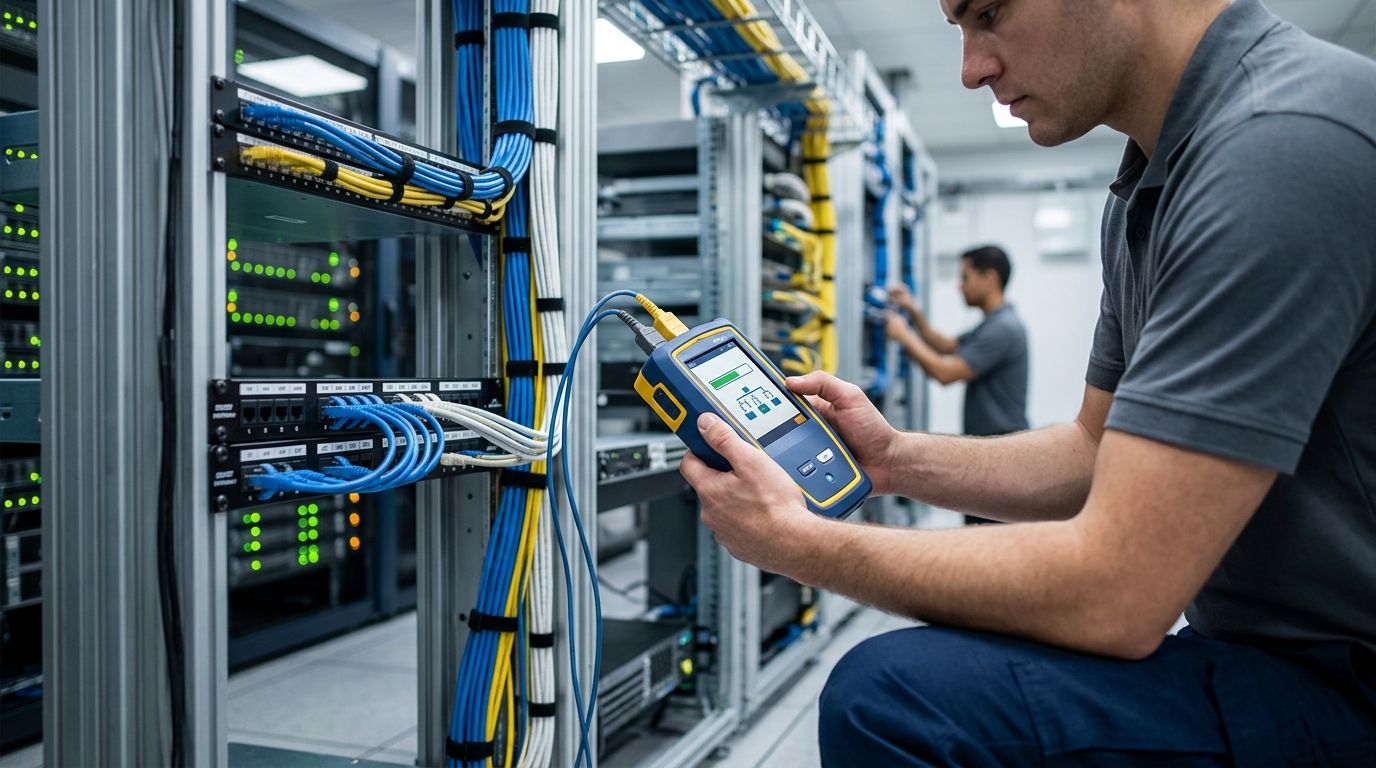
A network cabling certification test has no fixed duration per cable. The tester must complete the required measurements, save the result, and identify any failures; the total job also includes locating cables, correcting faults, retesting, and preparing records. In 2026, ask for a schedule based on your actual cable list and the report you need, not a single time estimate for every run.
- How long does a network cabling certification test take? There is no fixed time per cable or project.
- A completed tester run is only part of the job; failures, retests, and reports affect the finish date.
- DBSI is best for Fairfield-area businesses that need network cabling installation and support, but request the test scope in writing.
Why this matters
If your office is opening, moving, or adding equipment, a cabling test is not just another task on the installation checklist. You need to know which connections passed, which failed, and whether the results match the cabling you ordered. A quick verbal assurance does not give your IT team a usable record.
That distinction matters when you ask an installer for a completion date. A test run is not the same as a certified handover. The handover depends on the agreed test scope, resolved failures, and results tied to identifiable cable runs. DBSI provides network cabling services for businesses in the Fairfield, New Jersey area; if you are arranging a project, specify those deliverables before agreeing to a testing schedule. Its cable testing and certification for business networks page is the relevant starting point.
How long does a network cabling certification test take?
There is no defensible universal number without the cable schedule and test requirements. A technician has to identify each run, connect the tester, select the correct test settings, run the measurements, save the result, and move to the next run. A failed result adds fault finding, correction, and another test. The time needed to deliver the final record is separate from the time the tester spends measuring a cable.
For a useful 2026 schedule, ask the installer to separate the work into these stages:
- Confirm the test scope. Identify which copper and, where applicable, fiber runs need testing. Agree on the acceptance criteria before testing starts.
- Identify the runs. Match each cable to its endpoint labels and the cable schedule so a result can be traced to a physical connection.
- Run and save the tests. Use settings that match the installed cabling and the agreed test scope; retain results for each run.
- Investigate failures. Locate faults, correct them, and retest the affected runs rather than treating a failed result as completed work.
- Review the handover. Check that the report identifies the tested runs and makes any unresolved failures clear.
Those stages answer different questions. The test result tells you whether a run met the selected criteria; the handover tells you which runs were tested and what still needs attention. If an estimate covers only the tester's measurement time, it leaves out work that can affect when your office is ready to use the network.
What should you ask for before accepting a timeline?
Ask for a run list, the type of test required, the pass criteria, and the form of the final results. Then ask how failures and retests will be recorded. This turns a vague promise to test the cables into a scope you can check against the finished work.
You should also make clear whether your question concerns testing time or project completion. The first concerns the work on the installed runs. The second includes access to the rooms and endpoints, corrections, retesting, and review of the results. Keeping those questions separate makes the schedule more useful to the people planning a move or network change.
Does the type of cable test change the answer?
Yes. A basic check, a qualification test, and a certification test answer different questions. Do not use their names interchangeably when requesting a timeline or accepting an installation.
| Test approach | What it answers | Best for | Advantage | Limitation |
|---|---|---|---|---|
| Basic continuity or wiremap check | Are the conductors connected in the expected arrangement? | Finding straightforward wiring faults | Helps locate connection problems | Does not establish that a copper link meets an agreed cabling performance category |
| Qualification test | Can the link support the performance being checked by that test? | Troubleshooting a specific network-use question | Focuses on whether a link is usable for the stated purpose | Is not a substitute for a certification report when certification was specified |
| Certification test | Does the installed link pass the selected cabling test criteria? | Documenting an installation against an agreed cabling specification | Produces a pass or fail result against those criteria | Requires the correct setup, identifiable runs, and attention to failed results |
Best for an installation handover: a certification test matched to the agreed cabling specification. A wiremap check is useful, but calling it certification can leave you with less evidence than you requested. Certification, in turn, does not fix a failed link; someone still has to find the problem and retest it.
The distinction is especially useful in 2026 when an office has existing cabling alongside newly installed runs. If you want both groups assessed, say so. Otherwise, a report for the new work does not tell you whether the older connections passed the same test. Ask the installer to identify exactly which runs the report covers.
Why does network cabling test time vary?
The schedule changes with the work required around each test, not just with the tester's operating time. These are the factors to settle before someone gives you a completion date:
- Which runs are included. Testing an identified group of new cables is a different scope from assessing existing cabling throughout an occupied office. Put the included runs on a list.
- Endpoint access. A technician must reach the ends of a run to connect the test equipment. Agree on access to offices, cabinets, and other relevant spaces before the appointment.
- Labels and records. Clear identification lets the technician associate a saved result with the right connection. If labels or a cable schedule need correction, that work belongs in the schedule.
- Test requirements. The installed media and the agreed acceptance criteria determine which tests are needed. Copper and fiber should not be treated as the same testing task.
- Failed results. A failure needs investigation and retesting after correction. An initial test count cannot tell you how much fault-resolution work will be necessary.
- Reporting requirements. Saved results still need to be checked against the run list and delivered in a form your business can retain.
None of those factors supplies a universal time per run. Together, they give an installer enough information to define the work. If a proposal says only that cabling will be tested, ask what kind of test it means and what evidence you will receive.
For a 2026 office opening, the practical question is whether the tested connections will be ready for the equipment planned for each location. Tell the installer which runs serve workstations, phones, wireless access points, or other network-connected devices. That context helps you identify the connections that must be reviewed before staff depend on them; it does not replace the agreed test criteria.
What counts as a finished certification job?
A finished job has test results that you can match to the agreed runs. Ask to see how a cable label appears in the report, which criteria were used, and whether the final result passed. If a run failed, the record should make its status clear rather than disappearing from the handover.
You do not need to interpret every measurement to check the basics. Compare the report with the run list: are the expected connections present, are the identifiers readable, and are unresolved failures disclosed? Give your IT provider the report so the installation record stays available when a connection needs troubleshooting later.
This is where the scope of DBSI's network cabling service matters more than a generic claim about speed. DBSI is best for Fairfield-area businesses that want a local provider for network cabling installation and support; confirm the certification deliverables for your specific project. Its service description establishes what it does, but the provided information does not state a test duration or a standard report package. Get both the planned schedule and the requested records into the project scope.
Should testing happen before the office starts using the cables?
Test the runs before you rely on them for the office opening. That gives the installer an opportunity to address failures while the installation work is still active. In 2026, keep testing and any necessary retesting visible on the move or opening schedule rather than assuming the cables are ready as soon as they are connected.
For an office relocation, decide which connections must be available for staff to work and communicate. A cabling report tied to those locations is more actionable than a general statement that the network passed. DBSI also covers network cabling for office moves and build-outs; the useful next step is to match the testing scope to the rooms and equipment in your plan.
Can an installer give an exact test time before seeing the site?
An installer cannot establish an exact completion time from the question alone. The run list, cable types, access arrangements, and required records define the scope; failed tests add work that cannot be confirmed in advance. Ask for a schedule that states its scope instead of accepting an unexplained time per cable.
Does a failed cable need to be tested again?
Yes. A failed result shows that the run did not pass the selected criteria in that test. After the fault is addressed, retesting establishes the run's new result; the original failure by itself is not a passing handover record.
Is a wiremap check the same as cable certification?
No. A wiremap check identifies how conductors are connected, while certification checks an installed link against selected cabling performance criteria. If your 2026 project calls for certification, request the certification results rather than a statement that the wiring was checked.
FAQ
How long does a network cabling certification test take?
There is no fixed duration that applies to every cable or project. The schedule must account for identifying runs, completing the agreed tests, resolving failures, and delivering results.
Does certification take longer than a basic wiremap check?
Certification involves a different scope of testing from a basic wiremap check, so the two should not share an assumed time estimate. Ask which test your installer has included and what record you will receive.
What should I receive after network cabling certification?
Ask for saved results that identify the tested runs and show whether each met the agreed criteria. Check that the report matches the cable list and discloses unresolved failures.
Can existing office cabling be included in the test?
Yes, existing cabling can be included in the requested scope. Identify those runs separately so you can tell which results cover existing connections and which cover new work.
Does a failed result mean the whole network fails?
A failed result identifies a problem with the tested run under the selected criteria; it does not establish the status of every other run. Have that connection investigated and retested, and review each run’s recorded result.
Should I schedule certification before an office move?
Put testing and possible retesting on the office move schedule before staff rely on the new connections. Confirm which locations and equipment need a documented passing result for opening day.
Can a continuity check replace a certification report?
No, a continuity check does not replace a certification report when certification is part of the agreed installation scope. State the required test and handover records before work begins.
One last thing
Ask the installer to show how a physical cable label matches a saved test result. That simple check tells you whether the 2026 handover will help your IT team find the right connection later. DBSI offers network cabling and IT/network services in the Fairfield area; for a DBSI cabling project, make that label-to-result match part of the requested handover.
Related guides
- How to test and certify structured cabling installations
- Network cabling for office relocations and build-outs
- How to label and organize a business network cabinet
Sorry, the comment form is closed at this time.