
16 Sep Access Control Cost Per Door in 2026: What Drives It
Access control installation cost per door in 2026 has no single flat number — a basic keypad on one retrofit door runs a fraction of what a biometric reader tied into a cloud platform across twenty doors costs, and the gap between those two jobs is wider than most vendors let on upfront. Wiring condition, reader hardware, and total door count move the number more than any brand name on the panel.
- Access control installation cost per door in 2026 depends on wiring condition, reader type, and door count — there is no flat national rate.
- Retrofitting a single door in an existing building costs more per door than wiring five or ten doors during new construction or a build-out.
- Biometric readers and mobile credential systems add hardware and software cost beyond a basic keypad or prox card reader.
- Cloud-based platforms often carry a per-door licensing fee that a one-time on-premise controller does not.
- DBSI brings over 15 years of professional experience to access control installation for businesses in the Fairfield, NJ area.
Why this matters
Businesses budgeting for access control installation in 2026 usually get a number from one vendor and assume it applies everywhere. It doesn't. A five-door office suite in a new build-out and a single retrofit door in a 1980s commercial building are two different projects with two different labor bills, even if both use the same card reader model.
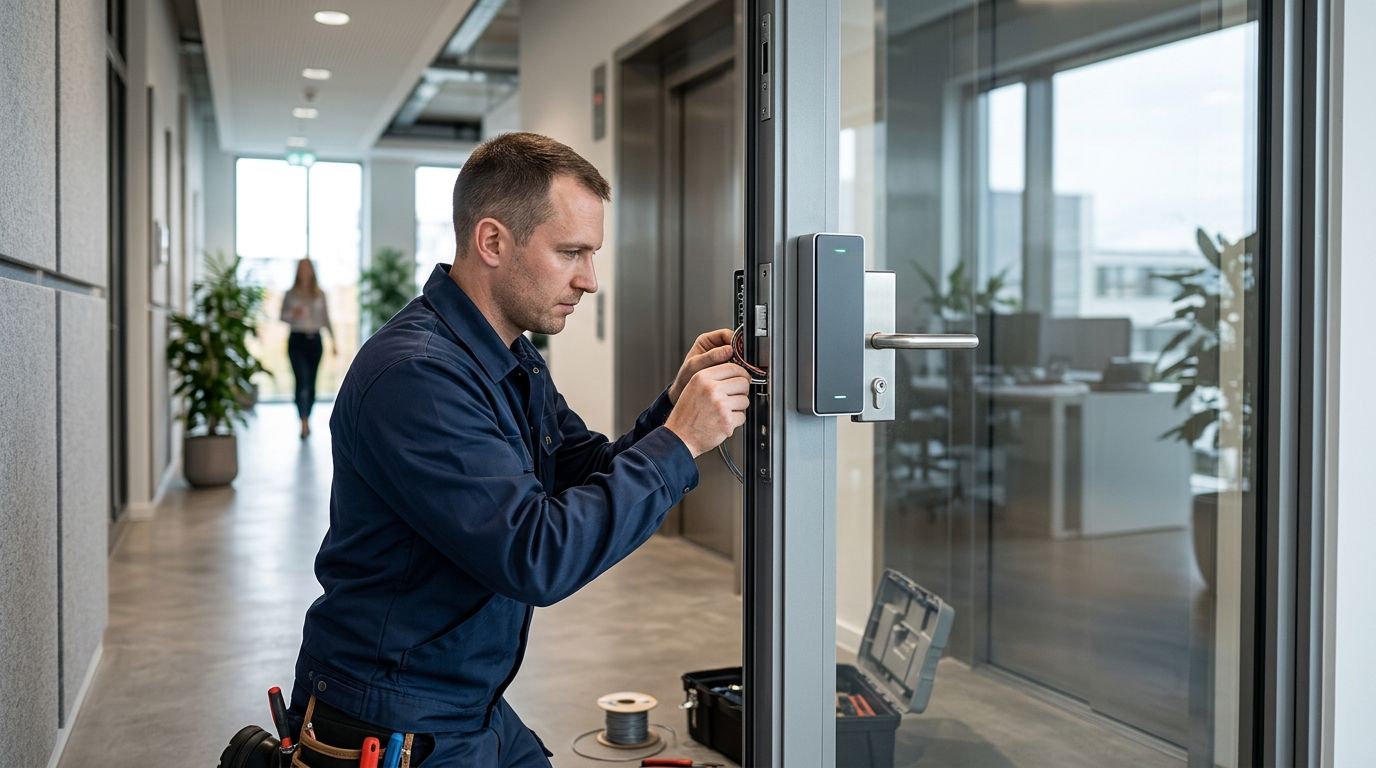
The hidden cost most owners miss isn't the reader — it's the wiring path. Pulling cable behind finished drywall, through fire-rated walls, or up through a ceiling plenum takes longer than running cable during an open-wall build-out, and labor is the line item that swings the per-door total the most.
How much does access control installation cost per door?
There's no fixed per-door rate that applies across every building type in 2026, because the same door can be wired three different ways depending on what's already in the wall and what the business needs the system to do. Instead of a single number, the table below shows what pushes a given door's installation cost up or down relative to a baseline single-door retrofit.
| Cost driver | Keeps per-door cost lower | Pushes per-door cost higher |
|---|---|---|
| Wiring condition | New construction, open walls | Retrofit through finished walls or fire-rated barriers |
| Reader type | Basic keypad or prox card | Biometric or mobile credential reader |
| Door hardware | Existing electric strike is compatible | New maglock or panic hardware required |
| Door count | Multi-door rollout spreads fixed costs | Single door absorbs the full site visit and setup cost |
| Software model | One-time controller setup | Cloud platform with per-door licensing |
| Integrations | Standalone system | Tied into fire alarm, video intercom, or camera system |
A business installing access control on one door in an older building sits at the expensive end of every row in that table at once — that's why a single-door quote often looks disproportionate to a ten-door quote on a per-door basis.
Standalone keypad and PIN locks
A standalone keypad lock skips the network entirely — it's a self-contained unit on the door with no controller wiring back to a panel. That keeps installation simple and the per-door labor bill low, but it also means no centralized audit log and no remote lockout if a code gets shared. Best for a single low-traffic door, like a supply closet or server room with one or two authorized users. Skip it for any door where you need to know who came and went.
Networked card and prox readers
A networked reader ties back to a controller and a management platform, which adds cabling and setup time compared to a standalone lock but gives you a real audit trail and instant credential revocation. This is the middle-of-the-road choice for most commercial doors. Buy for main entries, server rooms, and any door where you need a log of who entered and when.
Biometric readers
Biometric access control uses a fingerprint or facial scan instead of a card or code, which removes the risk of a shared or lost credential. The hardware costs more than a standard prox reader and setup takes longer because enrollment has to happen for every employee. Buy for high-security areas like data closets or cash-handling rooms. Wait on rolling it out to every door in the building unless credential sharing is an active problem.
Mobile credential (smartphone) systems
Mobile credential access control uses a smartphone app instead of a physical card, which cuts the ongoing cost of printing and replacing badges but usually runs on a cloud platform with a per-door subscription. Installation hardware is comparable to a standard networked reader. Buy for offices with frequent staff turnover where reissuing physical cards is a constant hassle.
Cloud-based platforms
A cloud-based system moves the management software off a local server and onto a hosted platform you log into from anywhere, which simplifies management across multiple locations. The tradeoff is an ongoing software cost that an on-premise controller doesn't carry. Buy for businesses with more than one location. Hold off if you have a single site and no plan to add more.
Why access control installation cost per door varies
- Wiring condition — pulling new cable through finished walls costs more labor hours than running it during an open-wall build-out
- Door hardware compatibility — an existing electric strike that works with the new system saves a hardware swap; a door needing a new maglock or panic bar adds cost
- Reader technology — keypads and prox cards install fastest; biometric and mobile credential readers take longer to configure and enroll
- Total door count — the site visit, network switch, and software setup are largely fixed costs that get spread thinner across more doors
- Software model — a one-time on-premise controller setup differs from a cloud platform's ongoing per-door licensing
- Integration requirements — connecting access control to a fire alarm, video intercom, or camera system adds configuration time beyond the door hardware itself
Does installing multiple doors at once lower the cost per door?
Yes — installing multiple doors at once lowers the average cost per door because the site visit, network switch setup, and software configuration are fixed costs that get divided across every door on the job. A ten-door rollout spreads those fixed costs across ten doors instead of one, which is why a single-door retrofit often looks expensive compared to a multi-door office fit-out quote.
Do I need new wiring for access control installation?
Not always — if a door already has an electric strike or maglock wired for an older access system, some of that cabling can sometimes be reused, which lowers labor cost. Older buildings with no prior access control wiring, or doors near fire-rated walls, typically need new cable runs pulled from scratch, which is the single biggest driver of per-door cost variation in 2026.
Most small and mid-sized businesses in the Fairfield, NJ area weighing access control systems for small offices start with a walk-through rather than a phone quote, because wiring condition can't be assessed accurately over email. DBSI has handled access control installation for offices, medical practices, and retail locations across New Jersey, and a site visit is the only way to price a job accurately rather than guess at a per-door average that may not apply to your building.
Get a door-by-door installation quote
A site walk-through gives exact numbers for your doors, not a generic average.
FAQ
How much does access control installation cost per door in 2026?
There is no fixed per-door rate in 2026 — wiring condition, reader type, and total door count all move the number, sometimes by a wide margin between two doors in the same building. A site walk-through is the only reliable way to price a specific job.
Is a mobile credential system more expensive than a card reader system?
Mobile credential hardware is comparable to a standard networked card reader, but most mobile credential platforms run on a cloud subscription with an ongoing per-door fee that a basic card system may not carry. The tradeoff is lower long-term badge replacement cost.
Does access control installation require running new cable?
Only sometimes — doors with existing access control wiring can often reuse some of that cabling, while doors in older buildings with no prior wiring, or near fire-rated walls, typically need new cable runs pulled from scratch.
Is biometric access control worth the extra cost per door?
Biometric access control is worth the extra hardware and enrollment cost for high-security doors like data closets or cash rooms, where credential sharing is a real risk. For general office doors, a standard card or prox reader usually covers the need at lower cost.
Do cloud-based access control systems have ongoing costs beyond installation?
Yes — most cloud-based access control platforms charge a per-door software licensing fee in addition to the one-time installation cost, unlike an on-premise controller that’s typically a one-time setup.
Can access control integrate with security cameras and fire alarms?
Yes — access control systems commonly integrate with video cameras and fire alarm panels, but each integration adds configuration time to the installation beyond the door hardware itself.
Does the number of doors change the per-door installation price?
Yes — installing several doors on one job spreads the fixed costs of the site visit, network setup, and software configuration across every door, which lowers the average cost per door compared to a single-door retrofit.
One last thing
The cost surprise that catches most businesses isn't the reader hardware — it's discovering mid-installation that the existing door hardware isn't compatible with the new electric strike or maglock, which turns a straightforward retrofit into a hardware swap. Get the door hardware checked during the walk-through, not after the wiring crew shows up, and the quote you get will actually hold in 2026.
Related guides
Sorry, the comment form is closed at this time.