
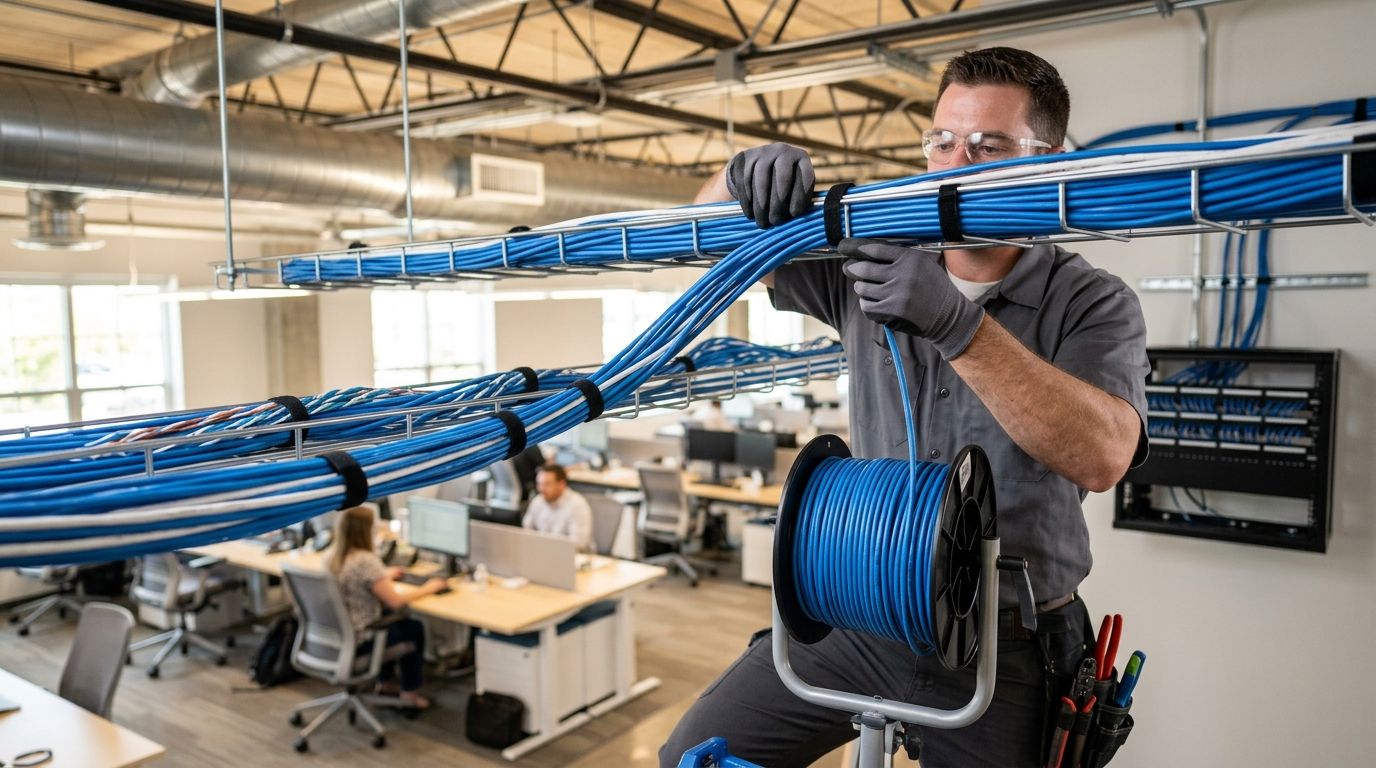
15 Sep Network Cabling Cost Per Foot in 2026: Real Price Range
Network cabling costs $1 to $8 per linear foot installed in 2026, and the number moves almost entirely based on cable category and how much of the building is already open. A standard Cat6 run in a typical office lands closer to $2.50 per foot once labor and termination are factored in — but that number doubles fast once you add plenum-rated jacket requirements or fiber optic backbone runs.
- Network cabling costs $1 to $8 per foot installed in 2026, depending on cable category.
- Cat6 averages around $2.50 per foot; Cat6a and fiber optic runs cost more due to shielding and termination time.
- Labor to fish cable through finished walls and ceilings usually costs more than the cable itself.
- Cat6 and Cat6a copper cabling is capped at a 100-meter (328-foot) run length under the TIA/EIA-568 standard.
- DBSI installs Cat5e, Cat6, Cat6a, and fiber cabling for offices in Fairfield, NJ and the surrounding area.
Why this matters
A per-foot number sounds simple until you're pricing out an actual office. A 10,000 square foot floor with 40 workstations, a few wireless access points, and a couple of security cameras needs a lot more than 40 straight lines of cable — it needs drops routed through ceilings, walls, and sometimes conduit, each one terminated and tested.
That's why the per-foot figure is only useful as a planning tool, not a final quote. Anyone planning network cabling for a new office space needs the per-foot cost plus a realistic count of drops, run lengths, and labor conditions before a number means anything.
Cabling is also the layer everything else depends on. Phone systems, WiFi access points, and security cameras all run over the same cabling backbone, so underspecifying it now means re-running cable later at a higher cost than doing it right during a build-out or office relocation and build-out cabling project.
How much does network cabling cost per foot in 2026?
The per-foot number changes by cable category more than by anything else. Here's how the categories stack up in 2026:
| Cable Type | Installed Cost Per Foot | Max Speed | Best For |
|—|—|—|
| Cat5e | $1.00 – $2.00 | 1 Gbps | Legacy networks, budget-limited projects |
| Cat6 | $1.50 – $3.00 | 1-10 Gbps (limited distance) | Standard office networks in 2026 |
| Cat6a | $2.50 – $5.00 | 10 Gbps | High-density offices, server rooms |
| Fiber optic | $3.00 – $10.00 | 10+ Gbps | Backbone runs, data centers, long distances |
Cat6 sits in the middle and covers most small and mid-sized office needs today. Cat6a and fiber cost more per foot but carry more traffic without slowing down, which matters more every year as offices add cloud phone systems, wireless access points, and networked cameras to the same backbone.
Cat5e cabling: $1 to $2 per foot
Cat5e is the cheapest option and still handles basic 1 Gbps traffic, but it's aging out of new installs. Cat5e is a Wait for any office planning to run past 2028 — it works today but won't support the bandwidth most new phone and camera systems expect within a few years.
Cat6 cabling: $1.50 to $3 per foot
Cat6 is the default choice for new office cabling in 2026. It supports 10 Gbps over shorter runs and 1 Gbps over the full 100-meter channel length. Cat6 is a Buy for most standard office networks — it balances cost against real-world bandwidth needs without over-spending on capacity most desks won't use.
Cat6a cabling: $2.50 to $5 per foot
Cat6a carries 10 Gbps over the full 100-meter run and shields better against interference, which matters in buildings with heavy electrical equipment nearby. Cat6a cabling is a Buy for server rooms and high-density floors, but it's overkill for a small office with a handful of workstations.
Fiber optic cabling: $3 to $10 per foot
Fiber optic cabling costs the most per foot but has no practical distance limit the way copper does and carries far more bandwidth. Fiber optic cabling is a Buy for backbone runs between floors or buildings — anywhere copper's 100-meter cap becomes a real constraint.
Why network cabling costs vary
Six factors push the per-foot number up or down more than anything else:
- Cable category — Cat5e, Cat6, Cat6a, and fiber each carry a different material and termination cost.
- Conduit requirements — running cable through metal conduit costs more in labor than an open ceiling drop.
- Plenum-rated jacket — cable running through HVAC air-handling spaces needs a fire-retardant plenum jacket, which costs more than standard riser-rated cable.
- Run length and drop count — longer runs and more termination points multiply labor time even when the per-foot cable cost stays flat.
- Building age and construction type — older buildings with finished walls cost more to fish cable through than an open build-out.
- Local labor rates — commercial cabling labor in the New Jersey metro area runs differently than in lower-cost regions.
“If the walls are already open during a build-out, cabling costs drop fast because labor is the expensive part, not the cable.”
DBSI installs structured cabling — Cat5e through Cat6a and fiber — for offices, medical practices, and warehouses across Fairfield, NJ and the surrounding area, and plans cable category and routing around what the network actually needs to run today and in a few years.
Get a network cabling estimate
Talk through drop count, cable category, and building conditions before you budget.
Is Cat6 or Cat6a better for a new office network?
Cat6a is better for offices that need 10 Gbps over the full 100-meter run or that sit near heavy electrical equipment; standard Cat6 covers most everyday office traffic at a lower installed cost. Choose Cat6a for server rooms and high-density floors, and Cat6 for typical workstation drops.
How much more does fiber optic cabling cost than copper?
Fiber optic cabling costs roughly $1.50 to $7 more per foot than copper cabling, depending on whether you're comparing it to Cat6 or Cat6a. The premium buys distance beyond copper's 100-meter cap and higher sustained bandwidth for backbone runs between floors or buildings.
Does the network cabling cost per foot include labor?
Most per-foot cabling quotes bundle material and labor together, but the split varies by contractor and by job. Complex runs through finished walls or tight ceiling spaces shift more of that per-foot number toward labor than material.
FAQ
How much does network cabling cost per foot in 2026?
Network cabling costs $1 to $8 per foot installed in 2026, with Cat6 averaging around $2.50 per foot for a typical office run. The exact number depends on cable category, conduit needs, and how much of the building is already open.
Is Cat6 or Cat6a better for a new office?
Cat6a is better for high-density floors and server rooms that need full 10 Gbps over 100 meters, while Cat6 covers standard workstation traffic at a lower cost. Most small offices in 2026 still run Cat6 for everyday needs.
How much does structured cabling cost for a whole office?
Total structured cabling cost depends on drop count and run length, not just the per-foot cable price, since labor for fishing cable and terminating drops usually makes up most of the bill. A realistic estimate needs a drop count and floor plan, not just a per-foot number.
Does plenum-rated cable cost more than riser-rated cable?
Plenum-rated cable costs more than riser-rated cable because its fire-retardant jacket is required in HVAC air-handling spaces by building code. Buildings that route cable through return-air ceilings need plenum-rated cable regardless of the added cost.
Is it cheaper to run cabling during a build-out than after move-in?
Running cabling during a build-out is cheaper because walls and ceilings are still open, cutting the labor time needed to fish cable through finished spaces. Waiting until after move-in adds cost even though the cable itself is identical.
What’s the maximum run length for Cat6 cabling?
Cat6 and Cat6a cabling are capped at 100 meters (about 328 feet) per channel under the TIA/EIA-568 standard. Runs longer than that need a fiber optic backbone or a network switch placed closer to the endpoint.
One last thing
The per-foot number gets all the attention, but the 100-meter copper limit is what actually forces a lot of cost decisions. Offices with a data closet in the wrong spot on a large floor plan often need fiber optic cabling between switches just to stay inside that limit — not because copper is worse, but because the building layout runs longer than copper can carry a signal.
Related guides
- Cat6a cabling for high-speed business networks
- Fiber optic cabling for small business networks
- Cable testing and certification for business networks
Sorry, the comment form is closed at this time.