05 Sep Best Keycard Access Control for Manufacturing Plants 2026
Manufacturing plants run multiple shifts, restrict chemical storage and tool cribs, and can't afford a badge reader that jams during a line change. This guide ranks the keycard access control systems that hold up on a factory floor in 2026, not just in a corporate lobby.
- HID Global wins overall for manufacturing plants needing a proven credential standard across multiple buildings.
- Honeywell Pro-Watch is the pick for large industrial sites that need fire and security integration in one panel.
- Software House C-CURE 9000 fits regulated manufacturers in aerospace, defense, or pharma.
- Genetec Synergis is best when cameras and access control need to run from one interface.
- Brivo and Kisi cover cloud management and mobile credentials for plants without a dedicated IT team.
Why this matters
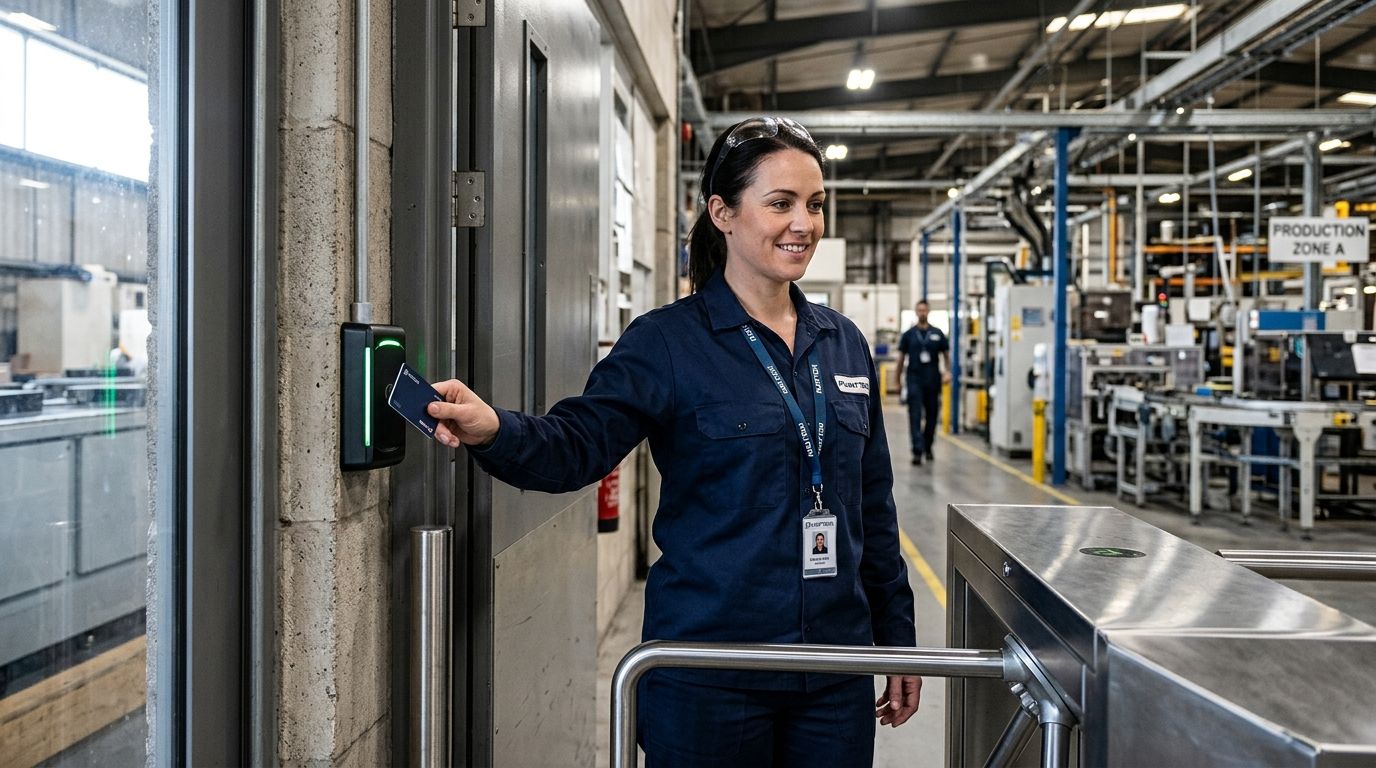
A keycard access control system on a manufacturing floor does more than lock a door. It logs who entered the chemical storage room at 2 a.m. on second shift, keeps a subcontractor out of the server closet, and feeds an audit trail when OSHA or an insurance adjuster asks who was in a restricted zone. Get the access control system wrong and you're re-badging 200 employees a year later.
DBSI has installed and supported keycard access control for manufacturing and industrial clients in Fairfield, NJ and the surrounding area for over 15 years, and the same short list of vendors keeps showing up as the right fit for plant environments. This ranking is built around what actually matters on a shop floor in 2026: badge durability, zone-based permissions, and integration with the cameras and phones a plant already runs.
Best overall: HID Global. Best for large industrial sites: Honeywell Pro-Watch. Best for regulated manufacturers: Software House C-CURE 9000. Best for unified video and access: Genetec Synergis. Best cloud option for lean IT teams: Brivo. Best for mobile credentials: Kisi.
What makes the best keycard access control system for manufacturing plants
- Badge-in/badge-out logging with exportable time-and-attendance data for shift audits
- Zone-based permissions that separate the factory floor from chemical storage, tool cribs, and server rooms
- Durability — readers and credentials that survive dust, grease, and gloved hands
- Integration with existing security cameras, video intercoms, and phone systems
- Cloud or on-premise management depending on whether the plant has dedicated IT staff
- Credential flexibility — proximity cards, mobile credentials, or biometrics for a three-shift workforce
Keycard access control systems for manufacturing plants at a glance
| System | Best for | Standout feature | Key limitation |
|---|---|---|---|
| HID Global | Multi-building manufacturing campuses | Widely deployed credential and reader standard | Requires a compatible reader ecosystem, not a single turnkey app |
| Honeywell Pro-Watch | Large industrial facilities | Ties access control into fire and life-safety panels | Setup complexity favors sites with an integrator on call |
| Software House C-CURE 9000 | Regulated manufacturers (aerospace, defense, pharma) | Granular audit trails built for compliance reporting | Steeper learning curve for smaller plants |
| Genetec Synergis | Plants unifying cameras and access control | One interface for badges and video footage | Best value shows up at larger camera-and-door counts |
| Brivo | Small to mid-size plants without in-house IT | Fully cloud-managed, no on-site server | Depends on internet uptime for real-time control |
| Kisi | Multi-entrance plants wanting mobile credentials | Phone-based badge-in, no physical card to lose | Staff without smartphones still need a fallback credential |
1. HID Global: best keycard access control for multi-building manufacturing campuses
HID Global makes the proximity cards, iCLASS credentials, and Signo readers that show up in more manufacturing access control installs than any other single brand. It's the credential standard most integrators build around, which matters when a plant has a main building, a warehouse, and a separate office trailer that all need to share one badge.
HID Global pros:
- Broad reader compatibility across older and newer panel systems
- Credential formats that scale from a single door to a full campus
- Long track record in industrial environments
HID Global pros (continued):
- Works with most third-party access control software rather than locking a plant into one platform
HID Global cons:
- The credential itself isn't a full system — it needs a panel and software layered on top
- Older prox cards are easier to clone than newer encrypted formats, so card selection matters
Best for: manufacturing operations with more than one building on badge access.
Verdict: Buy.
2. Honeywell Pro-Watch: best for large industrial facilities
Honeywell Pro-Watch is built for sites where access control, fire alarm, and life-safety systems need to talk to each other — a door that auto-unlocks on a fire alarm trigger, for example. That's a common requirement in larger manufacturing plants with sprinkler and suppression systems already wired into the building.
Pro-Watch pros:
- Integrates access control with existing fire and life-safety panels
- Handles high door counts across a single large facility
- Detailed event logging for safety and compliance reviews
Pro-Watch cons:
- Overkill for a single-building plant under a few dozen doors
- Configuration is usually handled by an integrator, not plant staff
Best for: large industrial facilities that need access control tied to fire and safety systems.
Verdict: Buy.
3. Software House C-CURE 9000: best for regulated manufacturers
Johnson Controls' Software House C-CURE 9000 is common in aerospace, defense, and pharmaceutical manufacturing where every badge swipe needs to hold up in an audit. It's built for granular permission sets — different clearance for the clean room, the loading dock, and the R&D lab, all logged separately.
C-CURE 9000 pros:
- Detailed, exportable audit trails built for compliance reviews
- Fine-grained zone permissions down to individual doors and time windows
- Established in defense and pharma manufacturing settings
C-CURE 9000 cons:
- Steeper setup and training curve than cloud-first platforms
- Better suited to plants with a compliance requirement driving the purchase, not general use
Best for: manufacturers under regulatory or contract compliance requirements.
Verdict: Buy for regulated plants; Skip for general manufacturing without a compliance driver.
4. Genetec Synergis: best for unifying video and access control
Genetec Synergis puts badge access and camera footage in one interface, so a security review of a break-in attempt at a loading dock door pulls the door log and the camera clip from the same screen instead of two separate systems.
Synergis pros:
- One dashboard for door events and video footage
- Scales well across plants that already run access control for warehouses and distribution centers
- Strong reporting for incident investigations
Synergis cons:
- Full value depends on running Genetec cameras alongside the access control
- Smaller single-door installs won't see the return on the unified platform
Best for: plants that want door events and camera footage in one place.
Verdict: Buy.
5. Brivo: best cloud-based option for lean IT teams
Brivo runs entirely in the cloud, which means no on-site server rack dedicated to access control. For a smaller manufacturing operation without a full-time IT hire, that's the difference between managing badges from a phone and maintaining a physical server.
Brivo pros:
- No on-premise server to patch or maintain
- Remote badge management from any location
- Faster initial setup than panel-based systems
Brivo cons:
- Real-time door control depends on a stable internet connection
- Deep zone customization is more limited than panel-based platforms like C-CURE
Best for: small to mid-size plants without dedicated IT staff.
Verdict: Buy.
6. Kisi: best for mobile credential access across multiple entrances
Kisi replaces the physical card with a phone-based badge, which cuts down on lost cards and the reissue cycle that comes with a rotating shift workforce. A plant with several entrances — main door, loading dock, employee side entrance — can manage all of them from one app.
Kisi pros:
- No physical card to print, lose, or clone
- Fast credential issuing and revoking for turnover-heavy shifts
- Works well alongside other mobile credential access control deployments across a company's other locations
Kisi cons:
- Employees without a compatible smartphone need a backup credential
- Battery-dead phones at a factory entrance are a real, if occasional, problem
Best for: multi-entrance plants that want to cut down on physical badge management.
Verdict: Buy for phone-friendly workforces; Hold if most staff don't carry a compatible smartphone on shift.
“If a manufacturing plant runs three shifts, the access control system needs to log every badge swipe without slowing down the line change.”
How we ranked
Each system above was weighed against the six criteria listed earlier — badge durability, zone permissions, integration with existing cameras and phone systems, cloud versus on-premise management, credential flexibility, and a track record in industrial settings. No two systems were ranked for the same use case, because a plant choosing between HID Global and Kisi isn't really comparing apples to apples — one is a credential standard, the other is a mobile-first platform.
Get access control installed right
DBSI installs and supports keycard access control for manufacturing plants in Fairfield, NJ.
Which keycard access control system should you choose?
A single-building plant with under 50 doors and no dedicated IT hire should start with Brivo for the cloud simplicity or HID Global credentials paired with a local panel. A multi-building campus with compliance obligations belongs on Software House C-CURE 9000. A plant that already runs security cameras and wants one screen for both belongs on Genetec Synergis. For most manufacturing operations weighing all six, HID Global remains the safest default in 2026 because it works with the widest range of panels and readers instead of locking a plant into one vendor's ecosystem.
FAQ
What is the best keycard access control system for a manufacturing plant in 2026?
HID Global is the best overall pick for most manufacturing plants in 2026 because its credentials and readers work across the widest range of panel systems. Plants with fire-safety integration needs or unified video should look at Honeywell Pro-Watch or Genetec Synergis instead.
Is biometric access control better than keycards for a factory floor?
Biometric access control adds a layer keycards can’t — it can’t be lent to a coworker or lost on the shop floor. Many manufacturing plants pair biometrics at high-security doors with standard keycards everywhere else rather than replacing badges entirely.
How much does keycard access control cost to install in a manufacturing facility?
Cost depends on door count, credential type, and whether the plant needs new cabling or can reuse existing infrastructure. Get a site-specific quote rather than relying on a flat industry number, since a two-door office and a 40-door plant aren’t priced the same way.
Can keycard access control integrate with security cameras?
Yes — platforms like Genetec Synergis are built specifically to unify door events and camera footage in one interface. Other systems can integrate with cameras through third-party software, though the setup depends on the specific brands involved.
Do keycard systems work for employees wearing gloves on a factory floor?
Proximity and iCLASS-style cards from HID Global don’t require touching a screen, so gloves aren’t an issue at the reader. Mobile credential systems that rely on a phone screen can be slower for gloved workers, which is worth factoring in for production areas.
What’s the difference between cloud-based and on-premise access control for manufacturing?
Cloud-based systems like Brivo manage badges and permissions remotely with no on-site server, while on-premise systems like C-CURE 9000 run on a local panel the plant controls directly. Cloud systems depend on internet uptime; on-premise systems depend on someone maintaining the server.
How long does it take to install access control in an existing manufacturing facility?
Timelines vary with door count, existing wiring, and whether the building needs new cabling runs. A plant with existing structured cabling installs faster than one starting from bare walls.
Is mobile credential access control secure enough for industrial facilities?
Mobile credentials from platforms like Kisi are generally considered secure for industrial use, since a phone-based badge is harder to clone than an older prox card. The main practical limitation is staff without compatible smartphones, who need a backup credential.
One last thing
The system that fails first on a manufacturing floor usually isn't the software — it's the reader hardware picked without accounting for dust, grease, or a three-shift schedule that never gives maintenance a quiet window to swap it out. Pick the credential format for the floor conditions first, then pick the software platform around it.
Related guides
- Cloud-based access control systems for business
- Best biometric access control systems for warehouses and distribution centers
- Mobile credential access control for office buildings
Sorry, the comment form is closed at this time.