
20 Sep Can Access Control Integrate With Payroll Software? 2026
Access control systems don't talk to payroll software directly out of the box — they connect through a time-and-attendance layer that translates badge swipes into hours worked, then hands those hours to a payroll platform like ADP, Paychex, or Gusto. The catch most businesses miss: the badge reader logs a door event, not a punch, so someone still has to configure rules for breaks, rounding, and overtime before payroll trusts the data.
- Access control systems integrate with payroll software through a time-and-attendance module or middleware, not a direct connection.
- Cloud-based access control platforms with open APIs connect to ADP, Paychex, and Gusto more easily than older on-premise badge systems.
- Badge-in/badge-out data still needs break, rounding, and overtime rules applied before payroll accepts it as timesheet data.
- Setup for a small office with under 50 employees typically runs a few weeks once the access control platform and payroll system are both in place.
- DBSI configures access control systems for Fairfield, NJ-area businesses that need this kind of payroll or HR integration.
Why this matters
A lot of small businesses buy an access control system to lock doors and end up discovering, months later, that the same badge data could kill their paper timesheets. That's a real cost saver — fewer manual entries, fewer disputed hours — but it only works if the access control platform and payroll software were built to share data in the first place. Some legacy keypad systems never export usable logs at all, and some payroll platforms only accept time data in a specific file format. Knowing which combination works before you sign a contract saves a rebuild in 2026 or 2027.
Can access control systems integrate with payroll software?
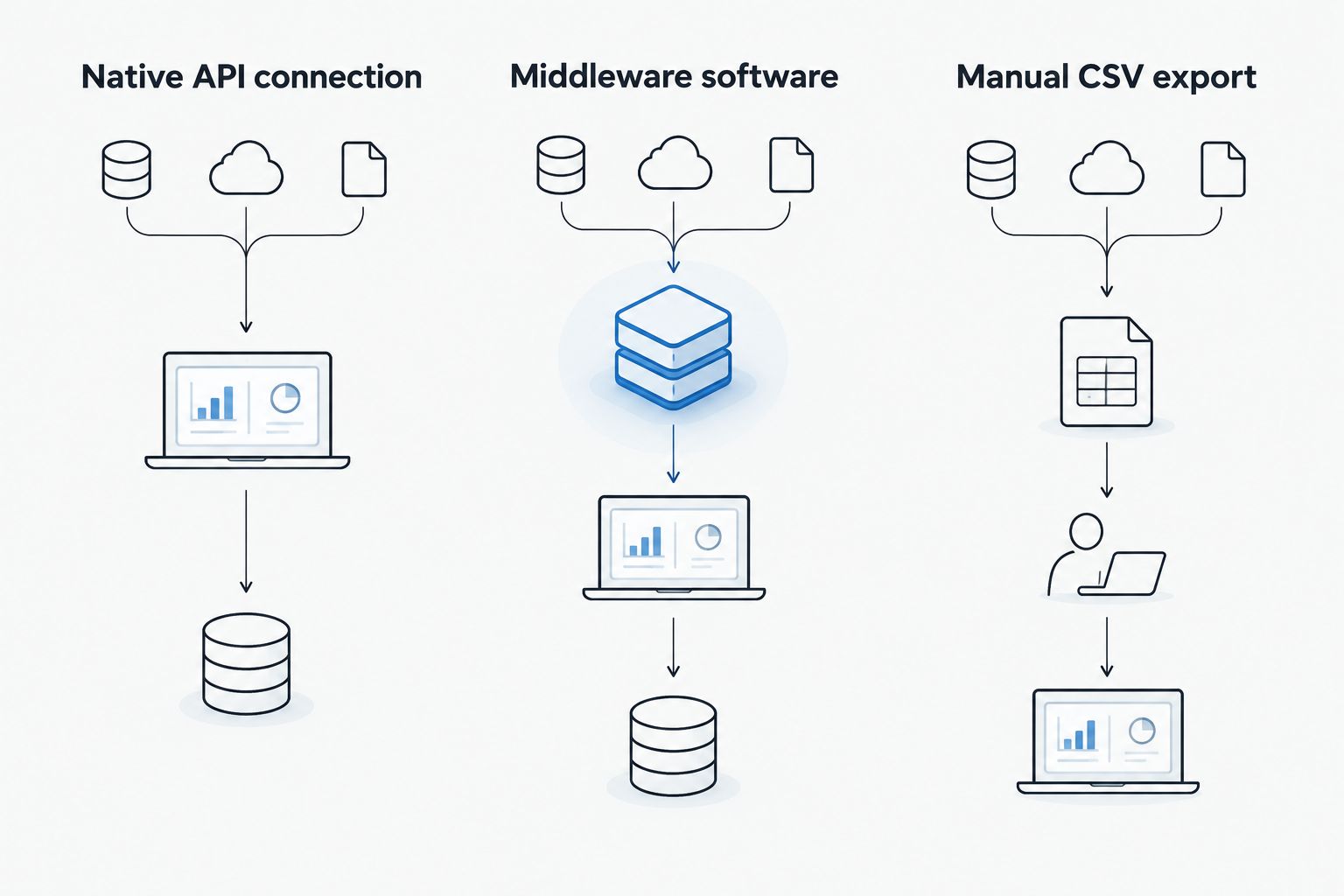
Yes, most current-generation access control systems can integrate with payroll software, but the path runs through one of three methods rather than a straight plug. Here's how each one actually works:
| Integration method | How it works | Best for |
|---|---|---|
| Native API connection | Access control platform pushes badge events directly to payroll or an HR system via API | Cloud-based systems with modern software, larger payroll vendors |
| Middleware / time-and-attendance software | A separate app sits between access control and payroll, converting badge data into timesheets | Businesses mixing older hardware with newer payroll software |
| Manual CSV export/import | Badge logs are exported and uploaded into payroll by hand on a schedule | Small offices with basic keypad or card systems |
A cloud-based access control system is the easiest starting point for payroll integration because the software already stores badge events in a database that other applications can query. Older standalone controllers usually require the middleware or manual-export route.
Native API connection: the closest thing to automatic
When an access control platform and a payroll system both expose APIs, a developer or integrator can connect them so badge-in and badge-out times flow into payroll without anyone touching a spreadsheet. This is the setup most large payroll vendors support for platforms with active partner programs. It requires more setup work upfront — mapping employee IDs, setting overtime rules, testing edge cases like a badge that fails to register a swipe — but once it's running, it needs almost no manual maintenance.
Middleware and time-and-attendance software: the common workaround
Most small and mid-sized businesses in 2026 still run access control and payroll on systems that were never designed to talk to each other directly. Time-and-attendance middleware fills that gap: it pulls badge logs from the access control system on a schedule, applies the business's break and overtime rules, and formats the output so payroll software can import it. This is the route most businesses land on when the access control system was chosen for security first and integration second.
Manual export: the fallback that still works
For a small office running a basic keycard or keypad system, badge logs can often be exported as a CSV file and uploaded to payroll manually. It's not elegant and it doesn't scale past a handful of employees, but it beats a paper sign-in sheet and it works with almost any hardware, even systems installed a decade ago.
Why payroll integration complexity varies
Not every access control setup connects to payroll the same way. A few factors drive whether it's a quick project or a multi-step build:
- Age of the access control hardware — standalone controllers from before 2018 rarely export usable time data without middleware.
- Whether the payroll platform has an open API — some payroll software only accepts imports in specific file formats, others accept live data feeds.
- Number of employee badge types — mixing keycards, fobs, and mobile credentials across departments adds mapping work.
- Break and overtime rules — badge data records door events, not paid hours, so someone has to define how a lunch swipe or a late badge-in gets handled.
- Multi-location setups — businesses running access control across more than one site need the integration to reconcile time zones and site-specific schedules.
- IT resources on staff — a business without an internal IT team usually needs an outside integrator to build and maintain the connection.
Businesses evaluating a new system for the first time should read through how to choose an access control system for your business before assuming payroll integration is a given — not every platform on the market supports it out of the box.
“Badge data records a door event, not a paid hour — payroll integration is the step that turns one into the other.”
Does access control integration change installation cost?
Adding payroll integration to an access control project usually adds to the setup cost, separate from the per-door hardware price, because it requires software configuration and testing beyond the physical install. Businesses budgeting for a new system should review how much access control installation costs per door and treat payroll integration as its own line item rather than something bundled in automatically.
How does access control data get into an employee's timesheet?
Badge-in and badge-out events get logged with a timestamp and employee ID, then either an API feed or a middleware tool converts those timestamps into hours and sends them to payroll. The raw badge log by itself isn't a timesheet — it's the input a time-and-attendance rule set needs to build one.
Do I need new access control hardware to connect to payroll software?
Not always — many businesses connect existing badge readers to payroll through middleware without replacing hardware, as long as the reader logs events in a format the middleware can read. Systems older than roughly a decade sometimes can't export usable logs at all, which is the point where hardware becomes the limiting factor.
Is it worth integrating access control with payroll for a small office?
For an office with more than a handful of hourly employees, integrating badge data with payroll cuts the time spent reconciling manual timesheets and reduces disputes over clocked hours. For a small team on salary with no hourly time tracking need, the integration adds setup cost without much payoff.
Onboarding new hires with the right credentials from day one makes this integration cleaner down the line — see how to onboard employees with new access control credentials for the setup sequence that avoids duplicate employee IDs between systems.
Plan your access control setup
Get the system configured right the first time, payroll integration included.
FAQ
Can access control systems integrate with payroll software?
Yes, access control systems integrate with payroll software through a time-and-attendance layer or middleware, not a direct plug-in. Cloud-based access control platforms with open APIs connect more easily than older standalone systems.
What payroll systems work with access control badge data?
Payroll platforms like ADP, Paychex, and Gusto commonly accept time data from access control systems, either through a direct API partnership or a middleware import. The exact fit depends on which access control platform is in use and whether it has an active integration with that payroll vendor.
Does access control replace a time clock?
Access control can replace a dedicated time clock when badge-in and badge-out events are configured to feed a time-and-attendance system. Without that configuration, the badge reader only tracks door access, not paid hours.
How long does it take to set up payroll integration with access control?
Setup for a small office typically takes a few weeks once both the access control platform and payroll system are in place, covering employee ID mapping and overtime rule configuration. Larger multi-location setups take longer because of time zone and schedule reconciliation.
Can I integrate an old access control system with new payroll software?
Older standalone access control controllers can sometimes export badge logs as a CSV file for manual upload into payroll, but they rarely support a live API connection. Systems installed before roughly the late 2010s are the most likely to hit this limitation.
Is access control and payroll integration expensive?
Payroll integration adds a separate configuration cost on top of standard access control installation, since it requires software setup beyond the hardware install. The cost depends on whether the connection uses a native API, middleware, or manual export.
What’s the difference between access control and time-and-attendance software?
Access control manages who can open which door and when; time-and-attendance software takes those door events and turns them into paid hours for payroll. The two systems serve different jobs even when the same badge triggers both.
One last thing
The businesses that get the cleanest payroll integration in 2026 are the ones that pick a cloud-based access control platform up front instead of trying to retrofit an old keypad system later — retrofitting almost always means falling back to manual CSV exports. If payroll integration is even a maybe for your business, weigh it before the hardware purchase, not after.
Related guides
- How to choose an access control system for your business
- How much does access control installation cost per door
- Best door access control systems for small businesses
- How to onboard employees with new access control credentials
- Cloud-based access control systems for business
Sorry, the comment form is closed at this time.