

28 Sep Door Access Control Systems: Reuse Hardware? Yes (2026)
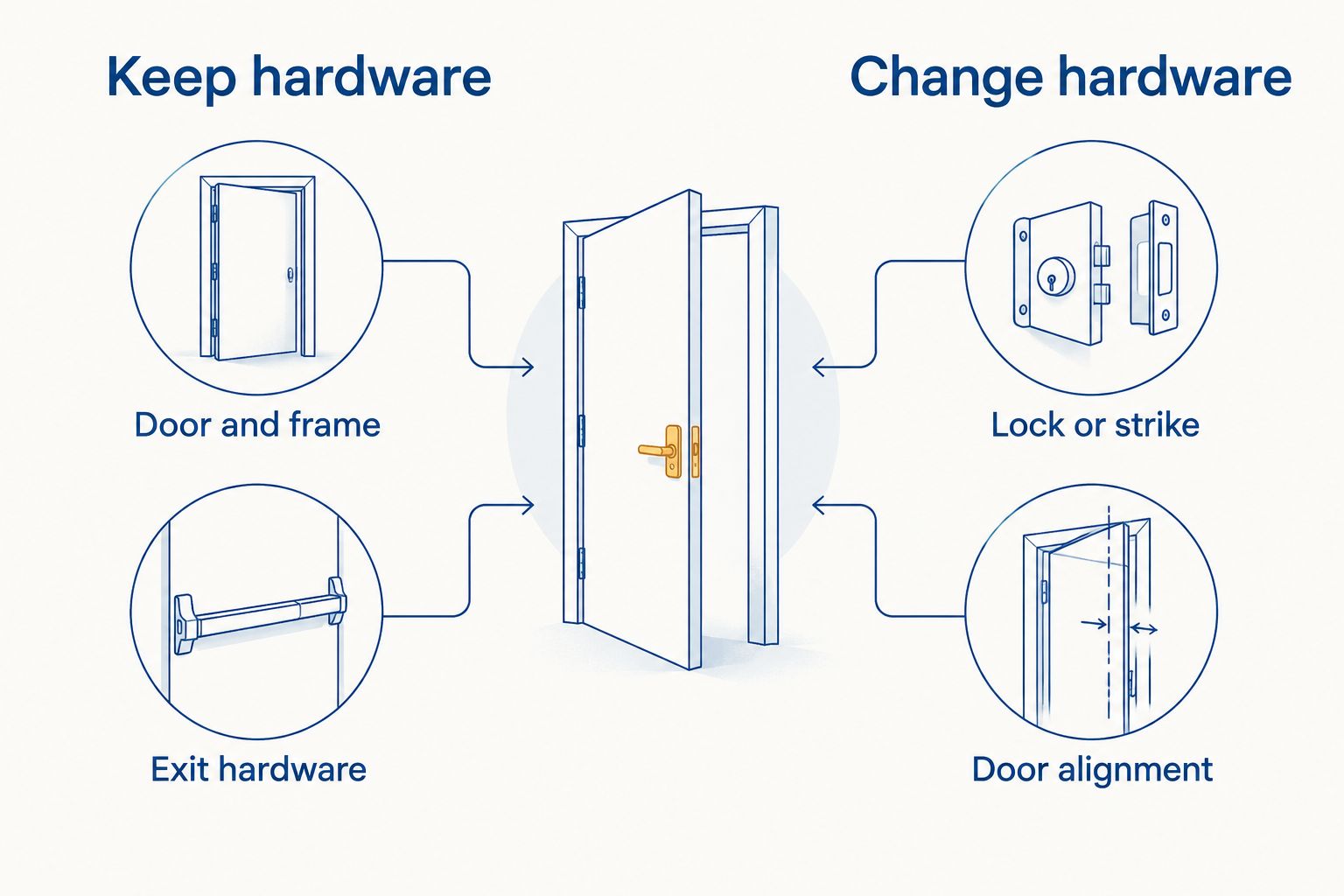
Yes. Door access control systems can work with existing door hardware when the door, lock, frame and exit hardware can accommodate the new equipment without interfering with normal operation or emergency exit. You may be able to keep the door and some mechanical parts while changing the lock or strike. The decision depends on a door-by-door inspection, not the age of the building.
- Yes: door access control systems can work with existing door hardware if the door locks and releases correctly after installation.
- Keep sound doors and compatible hardware; change parts that cannot support controlled entry or safe exit.
- For Fairfield-area businesses, DBSI is a practical contact for the network cabling and security-camera work around a door upgrade.
Can door access control systems work with existing door hardware?
Often, but reuse is selective. A reader and controller do not make an ordinary mechanical lock electrically controllable. The installer must identify how the door will lock, how people will leave, how the system will receive power and what happens when that power is lost.
| Existing condition | What can stay | What needs checking or changing |
|---|---|---|
| Sound door and frame with a mechanical lock | The door, frame, hinges and possibly the handle | Whether the locking hardware can be adapted or must be replaced |
| Door with an electric strike | The strike and other working hardware, if compatible | Strike operation, power requirements, controller connection and door alignment |
| Door with an exit device | The door and exit hardware, if the proposed setup preserves required exit operation | Device compatibility and the appropriate electrified locking method |
| Door that drags, fails to latch or has a damaged frame | Parts that remain serviceable after repair | Door alignment and reliable latching before access control is added |
The simplest starting point is to document each opening before selecting credentials or a controller. If you are planning work in an occupied office, this guide to installing access control in an existing office covers the broader installation sequence.
Why this matters
A new reader cannot compensate for a door that does not close or latch. The system can record an authorized entry while the physical opening remains unsecured. Check the door itself before deciding which existing parts to keep.
The reverse problem matters too: controlled entry must not obstruct required exit. Door hardware, building requirements and the proposed locking arrangement have to be reviewed together. That is more useful than choosing a credential first and trying to make the door fit afterward.
Which existing parts can you keep?
Keep the door and frame when they close properly
An existing door and frame are candidates for reuse when the door closes, aligns and latches reliably. Inspect the hinges, closer, frame and strike area while the door is in normal use. A door that only latches when someone pulls it shut needs attention before an electronic release is installed.
Check the opening from both sides. Interior office doors, shared entrances and doors on an exit path do not necessarily call for the same locking arrangement. Record the door's current behavior rather than assuming that every door of the same appearance has the same hardware.
Keep the lock or strike only when it fits the plan
An existing electric strike or electrified lock is not automatically compatible with a new controller. Its operating requirements, condition and behavior during a power loss still need to match the proposed setup. If those checks fail, retaining the part creates a weak point rather than a saving.
A standard mechanical lock can remain part of some arrangements, but it cannot become remotely controlled merely by adding a card reader beside the door. The locking method must be chosen for the actual opening. Keep working hardware because it fits the design, not because it is already installed.
Keep exit hardware only when exit remains correct
Exit devices need separate attention. A proposed change to controlled entry must preserve the door's required exit function. Do not select a locking device from a catalog photo and assume it works with the device already mounted on the door.
Ask the installer and door-hardware specialist to identify what changes on the entry side, what changes on the exit side and how the door behaves without power. If the answer is unclear, the hardware decision is not finished.
How do you check an existing door before installation?
Work through the opening in this order. The result is a clear record of what can stay, what needs repair and what must be selected for the access-control design.
- Test normal operation. Open and close the door as staff and visitors normally do. Note rubbing, incomplete latching, a weak closer or a strike that does not line up.
- Identify the current hardware. Record the lock, strike, handle, closer and any exit device. Note which side is used for entry and which side people use to leave.
- Define the access rule. Decide who needs entry, when they need it and whether the opening is used by staff, visitors or both. These choices affect reader placement and credential management.
- Check the proposed locking method. Confirm how authorization releases the door and whether the existing lock or strike supports that method. Do not assume that matching connectors or a working reader proves compatibility.
- Plan power and cabling. Identify the path for the controller, reader, locking hardware and any door-position monitoring in the proposed design. Verify that the required path can be installed without damaging parts you intend to retain.
- Confirm exit and power-loss behavior. Establish how people leave during normal operation and what the opening does when power is interrupted. Have the final arrangement checked against requirements for that door.
- Test the completed opening. Check authorized entry, denied entry, normal exit, closing and latching. Repeat the checks after any adjustment to the door or frame.
Keep the assessment tied to each opening. A working setup at the front entrance does not establish that a side entrance, stockroom or shared corridor door can use the same hardware.
Why does compatibility vary from door to door?
- Door alignment: A reader cannot fix a door that drags, stays open or fails to latch.
- Locking hardware: A mechanical lock, electric strike and electrified lock do different jobs. The existing part must support the chosen way of releasing the door.
- Exit hardware: The entry-side plan must preserve the exit function required at that opening.
- Power behavior: The team needs to know what the door does when power is interrupted, not just when the reader works normally.
- Cable path: The reader, controller and lock need suitable connections. An existing cable route is useful only if it serves the proposed equipment and installation.
- Door condition: Damage to the frame, strike area, hinges or closer can make an otherwise compatible locking method unreliable.
For a small office in 2026, this means the right question is not whether the building has old doors. It is whether each door can close, lock, release and allow exit as intended after the upgrade.
Can you add a reader without replacing the lock?
Only if the existing locking arrangement supports controlled release. A reader verifies a credential; another part of the system must act on that decision at the door. If the current mechanical lock has no suitable way to do that, the locking hardware or its arrangement needs to change.
Do not treat the reader as a substitute for a hardware inspection. In 2026, the useful specification for an existing opening is a documented entry, exit and power-loss sequence, followed by a list of parts to retain or change.
Can you reuse an existing electric strike?
Yes, if the strike is in good condition and compatible with the proposed controller, power and door operation. Check that it releases as intended and that the door latches when it closes. An installed strike that works intermittently is not a sound foundation for a new access system.
The same inspection should cover its behavior when power is lost. The correct arrangement depends on the opening and its requirements, so do not assume every existing electric strike is a direct replacement fit.
Will access control affect emergency exit?
It must not prevent the exit operation required for the door. The installer needs to assess the existing exit device, proposed locking method and applicable requirements before equipment is selected. If the plan changes how people leave, get that issue resolved before installation.
This is especially important when an opening serves more than ordinary staff entry. In 2026, keep the door's exit behavior in the written scope alongside its credential and power requirements.
Where does DBSI fit into an existing-door project?
DBSI is a Fairfield, New Jersey-area office technology provider whose stated work includes network cabling, commercial security cameras and IT/network services. Those services are relevant when a door project also needs network connections or camera coverage; the available information does not establish a specific access-control hardware offering. DBSI is best suited to a conversation about the office technology surrounding the door, while a door-hardware assessment determines what can be reused.
If cameras are part of your security plan, define their purpose separately from the access-control decision. A camera can show activity near an entrance; it does not establish that the door latched or that its lock is compatible. For a Fairfield-area business planning work in 2026, keep those requirements distinct in the project scope.
FAQ
Can door access control systems work with existing door hardware?
Yes, if the existing door and hardware can support the proposed locking method while preserving normal exit. Inspect each opening before deciding which parts to keep.
Do I need a new door to add access control?
No, not necessarily. A sound door and frame can often stay, but poor alignment, damage or unsuitable locking hardware must be addressed.
Can I keep my existing mechanical lock?
Sometimes. The proposed system needs a way to control entry at the door; a card reader alone does not make a mechanical lock electronically releasable.
Can an old electric strike work with a new access controller?
Yes, if the strike’s condition, operating requirements and door behavior match the new design. Have its release, latching and power-loss behavior checked.
Will access control stop people leaving during a power outage?
The door must maintain its required exit operation. Confirm the proposed lock’s power-loss behavior and the opening’s requirements before installation.
Should I fix a door that fails to latch before adding a reader?
Yes. Repair and test the door first, because a reader cannot secure an opening that does not close and latch reliably.
Can the same access-control hardware work on every office door?
Not automatically. Door condition, locking hardware, exit devices and cable routes differ, so each opening needs its own compatibility check.
One last thing
Test the door with the credential system out of the picture. If it does not close and latch consistently now, adding access control will not solve the physical problem. Repair the opening first, then specify the electronics. That order remains the sound choice for an existing-door project in 2026.
Related guides
- How to choose an access control system for your business
- Access control systems for small offices
- Can access control systems work during a power outage?
No Comments