
21 Sep Can Old Cat5 Handle Gigabit Speeds? 2026 Verdict
Old Cat5 cabling is not built for gigabit internet — it's rated for 100 Mbps Fast Ethernet, a full order of magnitude under the 1,000 Mbps gigabit standard. It can sometimes push gigabit traffic over very short runs under near-perfect conditions, but expect downshifted speeds, dropped packets, and intermittent connection drops as the cable ages further into 2026. If your ISP is billing you for gigabit and your office network still runs on original Cat5, you're paying for bandwidth the wiring can't deliver.
- Original Cat5 is rated for 100 Mbps, not gigabit — it was never certified for 1,000 Mbps traffic.
- Cat5e is the real gigabit minimum, rated for 1,000 Mbps over the full 100-meter run.
- Cat6 and Cat6a add headroom for 10 Gbps, which matters for growing networks past 2026.
- Gigabit signal over old Cat5 fails inconsistently, not completely — that’s the trap most offices miss.
Why this matters
A lot of small offices in New Jersey are still running on cabling pulled 15 or 20 years ago, long before gigabit internet was a standard business offering. The cable still carries a signal, so nobody thinks to check the category stamp printed on the jacket. That's the problem: a network can "work" on old Cat5 while quietly running at a fraction of the speed you're paying for.
Gigabit Ethernet (1000BASE-T) was designed around Cat5e and newer cabling, which is built with tighter twist rates and better shielding to control crosstalk at higher frequencies. Original Cat5 lacks those tolerances. Businesses that upgrade their internet plan without upgrading the Cat6a cabling for high-speed business networks underneath it often see the same slow speeds they had before the upgrade, and call their ISP to complain when the real bottleneck is in the walls.
Can old Cat5 cabling handle gigabit internet speeds?
The honest answer is inconsistent at best. Gigabit Ethernet needs all four twisted pairs in the cable to carry data simultaneously at a bandwidth Cat5 was never certified to handle. On a short, clean run — under roughly 50 feet, with no bends, splices, or interference — some old Cat5 cable will pass gigabit speeds. Add distance, age, or electrical interference from nearby conduit, and the connection starts dropping to 100 Mbps or failing outright.
Here's how the cable categories stack up on paper:
| Cable Category | Rated for Gigabit? | Max Rated Speed | Max Distance | Bandwidth | Verdict |
|---|---|---|---|---|---|
| Cat5 | No | 100 Mbps | 100 m | 100 MHz | Skip — replace it |
| Cat5e | Yes | 1,000 Mbps | 100 m | 100 MHz | Minimum viable |
| Cat6 | Yes | 1,000 Mbps (10 Gbps to 55 m) | 100 m / 55 m | 250 MHz | Recommended |
| Cat6a | Yes | 10,000 Mbps | 100 m | 500 MHz | Best for future growth |
Verdict: Cat5 is not a gigabit cable, full stop — Cat5e is the floor, and Cat6 or Cat6a is where most offices should land in 2026.
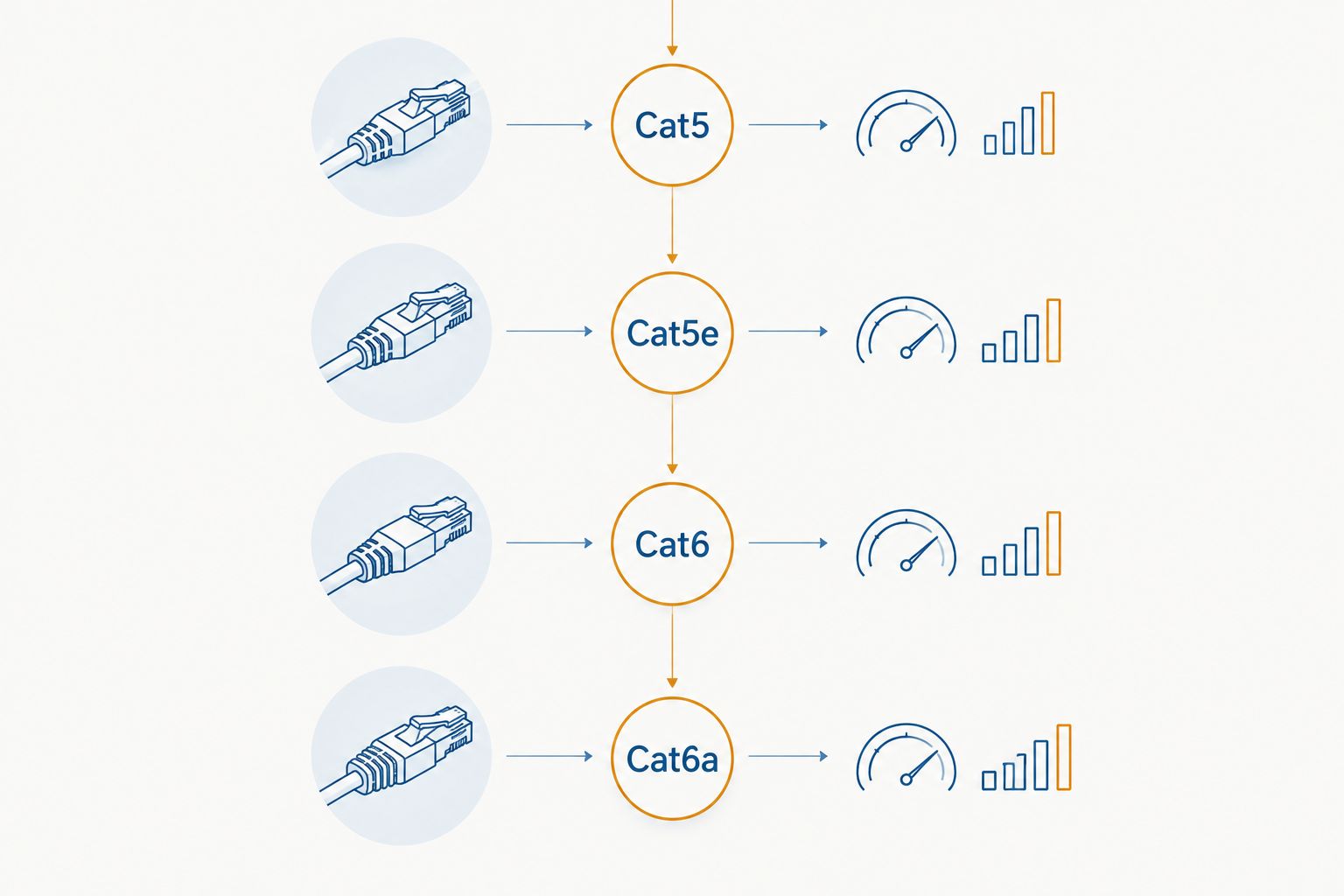
Cat5: 100 Mbps ceiling, not gigabit-rated
Cat5 tops out at a certified 100 Mbps and a bandwidth of 100 MHz, which is why it was the standard for Fast Ethernet, not gigabit. It was deprecated by the TIA in favor of Cat5e over two decades ago, and any cable still running today is well past its practical service life. Skip it — don't build a 2026 network around cabling that was never designed to carry gigabit traffic.
Cat5e: 1,000 Mbps, the real gigabit minimum
Cat5e is certified for the full 1,000 Mbps gigabit standard across a 100-meter run, using the same 100 MHz bandwidth as Cat5 but with tighter manufacturing tolerances that control crosstalk. It's the floor for a gigabit-ready office network, not the ceiling. Buy it if budget is the only constraint and you just need reliable gigabit today.
Cat6: 1,000 Mbps standard, 10 Gbps on short runs
Cat6 carries the same 1,000 Mbps gigabit rating as Cat5e but with 250 MHz of bandwidth, giving it room to run 10 Gbps over runs up to about 55 meters. For most office floors, that's plenty of headroom for switches, access points, and VoIP traffic on the same network. Buy it for any office planning to add wireless access points, PoE cameras, or more staff over the next few years.
Cat6a: 10,000 Mbps across the full 100 meters
Cat6a is rated for a full 10 Gbps at the standard 100-meter distance, with 500 MHz of bandwidth to handle it cleanly. It costs more to install than Cat6 or Cat5e, but it removes distance as a limiting factor for high-bandwidth gear like server rooms or data closets. Buy it if the office is doing a full build-out and doesn't want to re-cable again in five years.
Why gigabit performance varies on old cabling
Two runs of the same cable category can behave differently depending on how they were installed and how long they've been in service. The factors that actually move the needle:
- Cable age and physical wear — jackets crack, conductors oxidize, and connectors loosen over 15-plus years of service.
- Run length — every category has a rated maximum distance; longer runs degrade signal faster on marginal cable.
- Electromagnetic interference — cable bundled near fluorescent ballasts, motors, or electrical conduit picks up noise that lower-grade cable can't reject.
- Connector and patch panel quality — a gigabit-rated cable terminated with cheap connectors performs like a lower category.
- Physical damage — staples through the jacket, sharp bends, and crushed conduit runs all shorten a cable's usable bandwidth.
- Certification status — cable that was never tested and certified at install time is a guess, not a known quantity.
That last point is where most offices lose track of what they actually have running through the walls. Cable testing and certification for business networks is the only way to confirm what category and condition your existing runs are actually in before you plan an internet upgrade around them.
“If the cable in your closet is stamped CAT5 with no e after it, assume it caps out at 100 Mbps no matter what your ISP is billing you for.”
Does Cat5e cable really support gigabit speeds?
Yes, Cat5e is certified for the full 1,000 Mbps gigabit standard over a 100-meter run — that's the entire reason it replaced original Cat5 as the minimum spec. It uses the same 100 MHz bandwidth as Cat5 but with tighter manufacturing controls that keep crosstalk low enough for gigabit signaling to hold up reliably.
Is it worth replacing Cat5 cable just for gigabit internet?
Yes, if you're paying for a gigabit internet plan, replacing Cat5 is close to mandatory — the cable is the bottleneck, not the ISP connection. Running gigabit internet into a building still wired with original Cat5 means the fastest speed any device will reliably see is capped near 100 Mbps, regardless of what the modem delivers.
How do I know what category cable is already in my walls?
Check the printing on the cable jacket itself — it's stamped with "CAT5," "CAT5E," "CAT6," or "CAT6A" every few feet along the length. If the print is worn off or the cable predates that labeling convention, a certification test is the only way to confirm the category and condition without pulling it out.
DBSI installs and certifies structured cabling for offices around Fairfield, NJ that are outgrowing what's already in the walls, from a single Cat5e swap-out to a full network cabling for office relocations and build-outs project.
Get your cabling checked before you upgrade
Find out what’s actually running through your walls before you pay for gigabit you can’t use.
FAQ
Can old Cat5 cabling handle gigabit internet speeds?
Old Cat5 cabling is rated for 100 Mbps, not the 1,000 Mbps gigabit standard, so it can’t reliably handle gigabit speeds. Short, clean runs may pass gigabit traffic intermittently, but expect drops as the cable ages.
What speeds does Cat5 cable actually support?
Cat5 supports 100 Mbps at a certified level, using 100 MHz of bandwidth. It was designed for Fast Ethernet, not gigabit networking.
Is Cat5e the same as Cat5?
No, Cat5e is a different, newer specification built to reject crosstalk well enough to carry the full 1,000 Mbps gigabit standard. Cat5 lacks those tighter manufacturing tolerances.
Does Cat6 cabling improve speed over Cat5e?
Cat6 shares the same 1,000 Mbps standard rating as Cat5e but adds 250 MHz of bandwidth, enough to run 10 Gbps over runs up to about 55 meters. That extra headroom matters for growing networks.
Is Cat6a worth the extra cost for a small office?
Cat6a is worth it for offices planning a full build-out, since it carries 10 Gbps across the full 100-meter run instead of the shorter distance Cat6 needs for that speed. Smaller offices with no growth plans can stop at Cat6 or Cat5e.
How can I tell if my office cabling supports gigabit?
Check the category printed on the cable jacket — anything Cat5e or newer supports gigabit; plain Cat5 does not. A certification test confirms the category when the print is worn or missing.
Should I replace old cabling before switching to a gigabit internet plan?
Yes, replacing cabling rated below Cat5e before upgrading your internet plan avoids paying for bandwidth the wiring can’t deliver. The cable is the bottleneck, not the ISP connection.
Will gigabit internet work at all over old Cat5 cable?
It might work over very short, undamaged runs, but it’s unreliable and prone to downshifting to 100 Mbps or dropping the connection entirely. Treat any success on old Cat5 as luck, not a stable setup.
One last thing
The cable category printed on the jacket only tells you what the cable was rated for on day one — it doesn't tell you what it's actually delivering after 15 or 20 years behind drywall. A cable that tests clean today can degrade from a single crushed staple or a new fluorescent fixture installed six feet away next year. If your office is planning a gigabit upgrade in 2026, test before you commit to a plan speed you can't confirm the wiring will carry.
Related guides
- How to future-proof network cabling for a growing business
- How much does network cabling cost per foot
- Network cabling for office relocations and build-outs
Sorry, the comment form is closed at this time.