
23 Sep How Long Does Structured Cabling Installation Take (2026)
Structured cabling installation for a typical office takes 3 to 10 business days of on-site labor in 2026, ranging from a 1-day patch job for a handful of drops to 6 weeks or more for a multi-floor build-out. That window covers pulling, terminating, and labeling cable — it excludes the 1 to 3 weeks many projects need upfront for site surveys, design approval, and material lead times, plus the half-day to full day needed afterward for testing and certification.
- Structured cabling installation takes 3 to 10 business days on-site for most offices in 2026, plus 1-3 weeks of upfront planning and lead time.
- A small office with 10-20 drops finishes in 1 to 3 days; a 150+ drop multi-floor build-out runs 3 to 6 weeks.
- Material lead times and design approval, not cable pulling, usually add the most calendar time.
- DBSI schedules structured cabling work around business hours so the office stays open during the job.
- Testing and certification adds a half-day to a full day after the cable itself goes in.
Why this matters
An office move, expansion, or phone system upgrade usually has a hard deadline — a lease start date, a new hire class, a go-live date for a VoIP rollout. Structured cabling sits on the critical path for almost all of it, so a wrong estimate here pushes back everything downstream: phones, Wi-Fi access points, and security cameras all wait on cable drops being live.
Most owners also want to know whether structured cabling can be installed without disrupting an office while people are still working. The short answer is yes, with the right scheduling — but the timeline above assumes normal business-hours access unless you specifically ask for evening or weekend work.
How long does structured cabling installation take for an office?
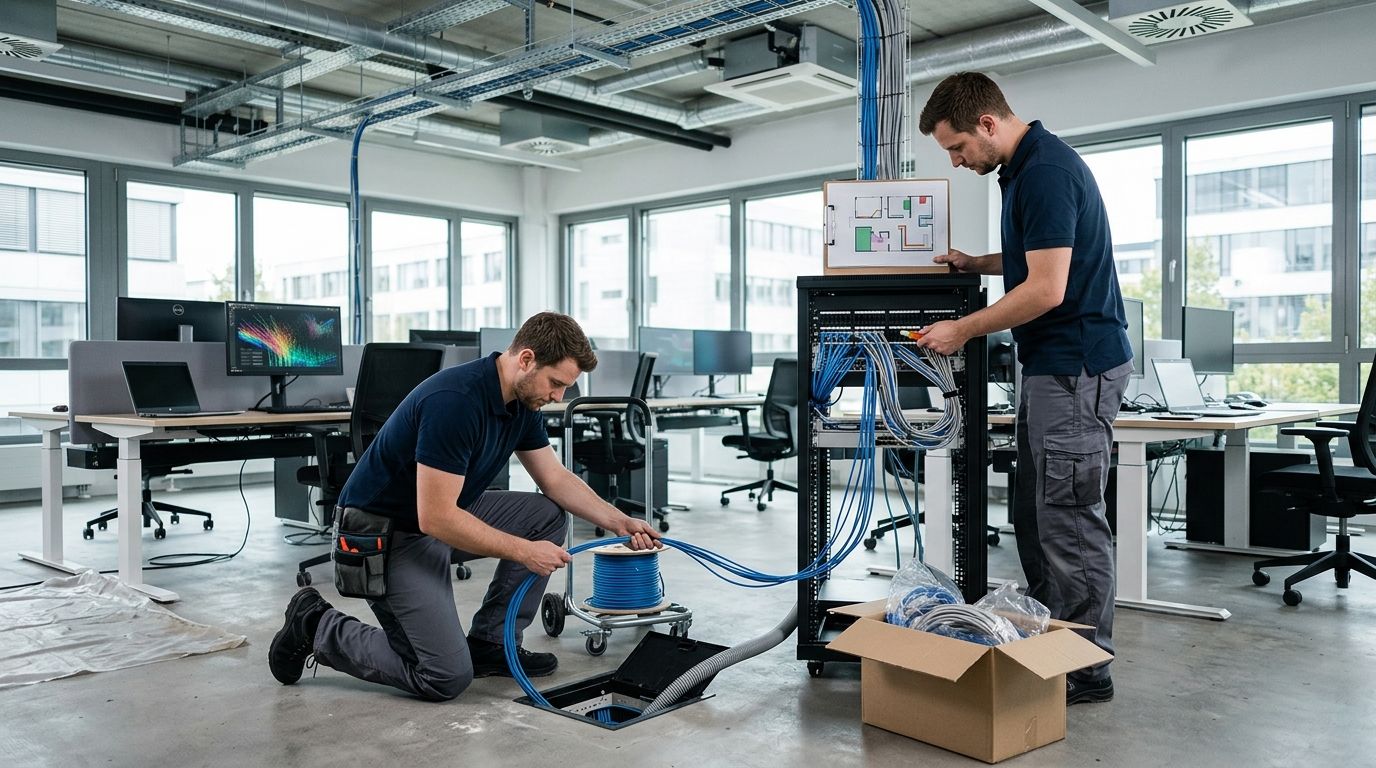
Every structured cabling job moves through the same five stages, no matter the office size: site walkthrough and design, material ordering, cable pulling and termination, testing and certification, and punch list and cleanup. On-site labor is usually the shortest of the five — material lead times and design sign-off eat more calendar days than the actual cable pulling does.
| Office size | Drop count | On-site install time |
|---|---|---|
| Small office | 10-20 drops | 1-3 days |
| Mid-size office | 50-100 drops | 1-2 weeks |
| Large or multi-floor office | 150+ drops | 3-6 weeks |
Small office (10-20 drops): 1 to 3 days
A single-floor office with 10 to 20 workstations typically needs one to three days of on-site cabling work. Most of that time goes to pulling cable to each drop, terminating jacks and patch panels, and running a quick test on each line. DBSI crews generally clear a job this size in a single visit without touching the office's normal working hours. Best for: startups and small professional offices finishing a build-out on a tight schedule.
Mid-size office (50-100 drops): 1 to 2 weeks
An office with 50 to 100 drops across one or two floors usually runs 1 to 2 weeks of on-site work. The extra time goes to longer cable runs back to the rack, more terminations to test and certify, and coordinating around desks, conference rooms, and shared spaces that are still in use. DBSI often splits this scope into phases so departments aren't all offline at once. Best for: growing companies doing a full-floor build-out or relocation.
Large or multi-floor office (150+ drops): 3 to 6 weeks
A large office or a building with 150 or more drops spread across multiple floors typically takes 3 to 6 weeks. Riser cable between floors, fire-stopping at penetrations, and a larger network cabinet all add time on top of the raw drop count. DBSI phases this kind of job floor by floor so the rest of the building stays operational while cabling work moves through it. Best for: corporate campuses, headquarters relocations, and data-heavy tenants.
Why cabling installation timelines vary
- Drop count and cable run length — more workstations and longer runs from the rack add days, not just cost.
- Existing building vs. new construction — pulling cable through finished walls and ceilings takes longer than an open shell.
- Cable type — Cat6A and fiber backbone runs take more time to terminate and test than standard Cat6.
- Business hours vs. after-hours work — scheduling around a live office adds coordination time but keeps operations running.
- Permits and inspections — some municipalities require permits for cabling tied into fire alarm or life-safety systems, which adds review time.
- Coordination with other trades — electricians, IT teams, and furniture installers on the same build-out can create scheduling gaps.
Offices that plan network cabling for a new office space before signing a lease or starting a build-out avoid most of these delays — the design phase happens in parallel with construction instead of after it.
Get a cabling timeline for your office
DBSI walks your site and gives you a written schedule before work starts.
Related questions about cabling timelines
How much does structured cabling installation cost per drop?
Structured cabling installation is priced per drop, and the exact rate depends on cable type, run length, and building conditions — see the full breakdown on how much structured cabling installation costs per drop. Higher drop counts generally lower the per-drop price but add calendar days to the schedule.
How long does it take to run cabling across multiple office floors?
Running cabling across multiple floors adds time for riser access, fire-stopping between floors, and coordinating elevator or stairwell shutdowns, on top of the per-floor drop count. A three-floor office with 150+ total drops commonly falls into the 3 to 6 week range described above.
Do you need to test and certify cabling after installation?
Yes — every structured cabling job should include testing and certification before it's called finished, which typically adds a half-day to a full day to the schedule. Skipping this step is how offices end up with intermittent network problems months after move-in.
FAQ
How long does structured cabling installation take for a small office?
A small office with 10 to 20 drops typically takes 1 to 3 days of on-site cabling work in 2026. Most of that time goes to pulling cable, terminating jacks, and testing each line.
Is structured cabling installation disruptive to daily business?
Structured cabling can be installed without shutting down an office when the work is scheduled around business hours or done in phases. DBSI routinely runs cable in occupied offices without pulling staff off their desks.
How much does structured cabling installation cost per drop?
Cost per drop depends on cable type, run length, and building conditions, and it usually drops as total drop count rises. The per-drop breakdown also affects how the project gets scheduled, since higher drop counts add calendar days.
How long does testing and certification take after cabling is installed?
Testing and certification typically adds a half-day to a full day after cable pulling and termination are done. This step confirms every drop meets the certified performance standard before the job is signed off.
What adds the most time to a cabling project?
Material lead times and design sign-off usually add more calendar days than the actual cable pulling. A vague drop count going into the estimate is the most common cause of schedule slippage.
Can cabling installation happen after business hours?
Yes, DBSI can schedule structured cabling installation for evenings or weekends so daytime operations aren’t interrupted. After-hours scheduling adds coordination time but keeps the office running normally during the day.
How long does a multi-floor office cabling job take?
A multi-floor office with 150 or more total drops typically takes 3 to 6 weeks in 2026. Riser cable between floors and fire-stopping at each penetration are the main reasons it runs longer than a single-floor job.
One last thing
The on-site cable pulling crew is rarely the bottleneck on a structured cabling project. The two things that blow up a timeline are a vague drop count going into the estimate and cable that has to be special-ordered.
“The two things that blow up a cabling timeline are a vague drop count and cable that has to be special-ordered.”
Nail down the exact number of drops per room before a site walkthrough, and confirm cable type and connector stock before signing off on the schedule. That alone keeps most office structured cabling installs inside the 3 to 10 day on-site window instead of sliding into extra weeks in 2026.
Related guides
- How long does it take to run cabling across multiple office floors?
- How to test and certify structured cabling installations
Sorry, the comment form is closed at this time.