
21 Sep Can a Cloud Phone System Keep Your Number? 2026 Answer
Yes — a cloud phone system can keep your existing business number through a process called number porting, and most local numbers transfer in 7-10 business days with zero downtime when the request is filed correctly. The hidden cost nobody mentions upfront: canceling your old carrier before the port finishes, or letting an unpaid balance sit on that account, can kill the port and force you to start over with a new number.
- A cloud phone system can keep your existing business number through standard number porting.
- Local numbers typically port in 7-10 business days; toll-free numbers take longer, often 2-4 weeks.
- Canceling your old carrier early or having an unpaid balance is the top reason ports fail.
- DBSI handles the port paperwork for Fairfield, NJ area businesses switching to a cloud phone system.
Why this matters
Business owners hear "cloud phone system" and picture ripping out their number along with the old hardware. That's not how it works. Your phone number belongs to you, not to your carrier, under FCC number portability rules that have been in place for years. The system changes; the number that's printed on your trucks, your invoices, and your Google listing doesn't have to.
The real risk isn't losing the number — it's mismanaging the transition and creating a gap where calls bounce to a disconnected line. That's what actually costs businesses money, not the switch itself.
Can a cloud phone system keep your existing business number?
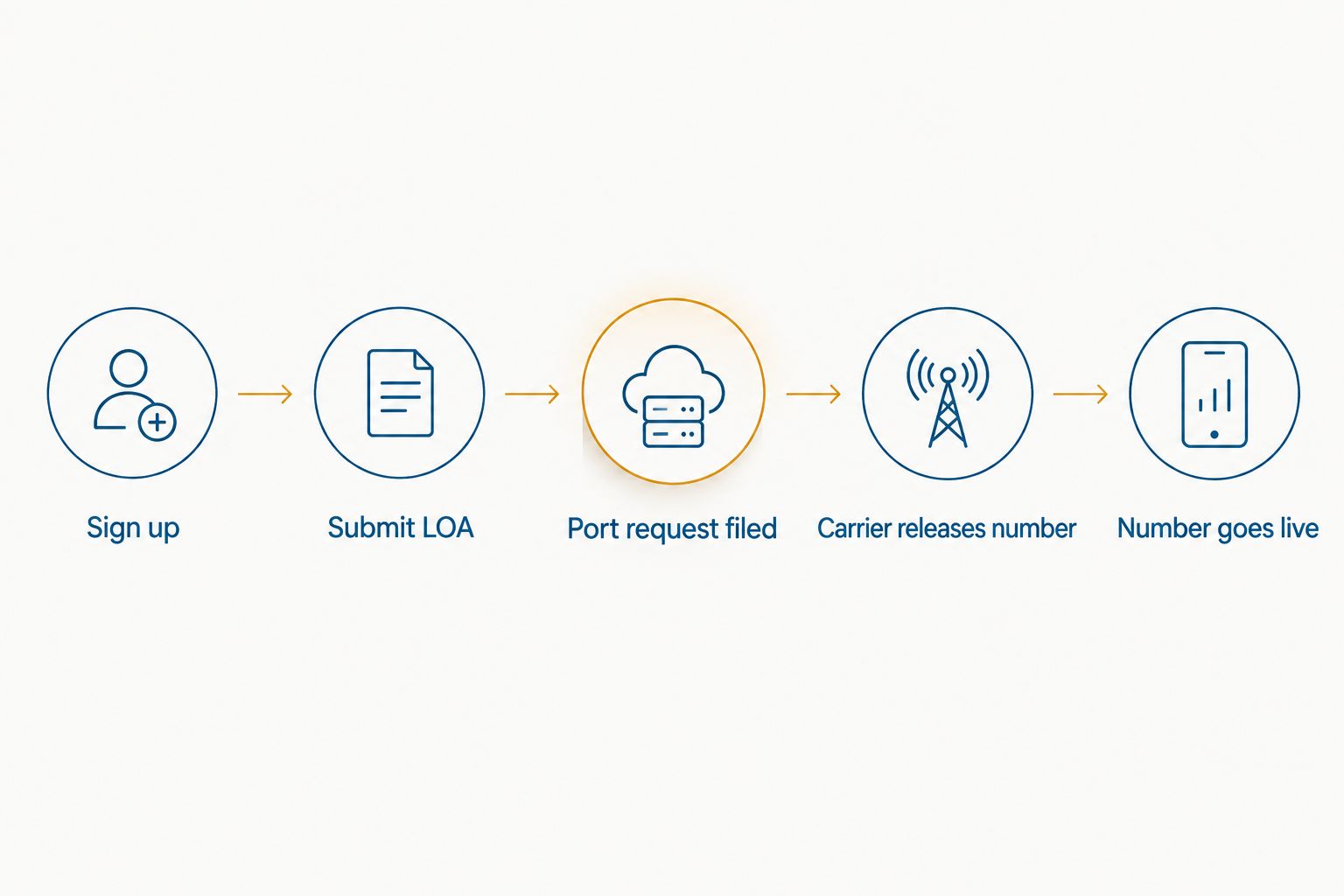
Here's the porting process from start to finish:
- Sign up with the cloud phone provider you're switching to and confirm which numbers you want ported.
- Submit a Letter of Authorization (LOA) — this must match your current carrier's account name, billing address, and account number exactly, or the request gets rejected.
- The new provider files the port request with your current carrier on your behalf.
- The losing carrier releases the number on the scheduled port date. Local numbers typically clear in 7-10 business days; toll-free numbers usually take 2-4 weeks.
- The number goes live on the cloud system. Calls route through the new platform the moment the port completes — there's no scheduled outage window if the LOA was accurate.
| Number type | Typical port time | What can delay it |
|---|---|---|
| Local landline number | 7-10 business days | Mismatched LOA info, unpaid balance |
| VoIP-to-VoIP number | 3-7 business days | Account not yet active with losing provider |
| Toll-free number | 2-4 weeks | Different porting system (RespOrg) than local numbers |
Keep your old service active until you get written confirmation the port is complete. Canceling early is the single most common way businesses lose a number they meant to keep.
Local numbers: 7-10 business days
Most small business main lines are local numbers, and these move the fastest. The losing carrier has a limited window under FCC rules to process a valid port request, which is why 7-10 business days is the standard range quoted across the industry. Delays almost always trace back to paperwork — a business name on the LOA that doesn't exactly match the carrier's records is the top cause of rejection.
Toll-free numbers: 2-4 weeks
Toll-free numbers run through a separate system called the RespOrg registry rather than the standard local number portability database. That's the reason a toll-free port takes longer than a local one even though the underlying request looks identical to the business owner. If a toll-free number is part of your marketing, plan the port date around a slower calendar than your local lines.
Why porting timelines vary
- Account information accuracy — any mismatch between the LOA and the losing carrier's billing record triggers a rejection and restarts the clock.
- Number type — local, VoIP-to-VoIP, and toll-free numbers each move through different systems at different speeds.
- Outstanding balances — a losing carrier can hold a port if the account isn't paid current.
- Number of lines — porting a block of 20 lines takes coordination that a single main line doesn't.
- Requested port date — you can schedule the cutover for after business hours or a weekend to avoid any perceived risk during peak call volume.
- Carrier responsiveness — some regional carriers process port-out requests slower than national ones, regardless of the FCC's standard timeline.
A cloud phone system provider that's handled hundreds of these knows which carriers drag their feet and builds the extra buffer into the project timeline instead of surprising you with it later. That's the difference between a smooth switch from a landline to a VoIP phone system and a week of missed calls.
What happens to my number during the port?
Your number keeps working the entire time — the old service stays active until the exact moment the port completes, so there's no gap where calls fail. Callers never notice a change beyond hearing your new system's greeting instead of the old one.
Can I port a toll-free number to a cloud phone system?
Yes, toll-free numbers can be ported to a cloud phone system, but expect 2-4 weeks instead of the 7-10 business days a local number takes. The delay comes from the separate RespOrg registry toll-free numbers are tracked in, not from any difference in how the cloud system handles the call once it arrives.
What if my current provider won't release my number?
A carrier cannot legally block a valid port request once your account is in good standing and the paperwork matches their records. If a port stalls past the normal window, the holdup is almost always an LOA mismatch or an unpaid balance — not the carrier refusing outright.
For businesses weighing the switch itself before worrying about porting mechanics, whether a cloud-based phone system is worth it in 2026 comes down to reliability during outages and per-user cost, both of which are separate decisions from keeping your number.
Move to a cloud phone system without losing your number
DBSI handles the port paperwork and setup for Fairfield, NJ area businesses.
Businesses in Fairfield, NJ that call DBSI about a cloud phone system usually ask the number question first — and after over 15 years installing business phone systems, the answer stays the same: the number moves with you, the hardware doesn't have to slow anything down, and the paperwork is the only part that takes patience.
FAQ
Can a cloud phone system keep your existing business number?
Yes, a cloud phone system can keep your existing business number through standard number porting, which typically takes 7-10 business days for local numbers in 2026. Toll-free numbers take longer, usually 2-4 weeks.
Does porting a number to a cloud phone system cause downtime?
No, a properly filed port causes no downtime because your old service stays active until the exact moment the new system takes over. Calls route seamlessly from the old carrier to the new cloud system on the scheduled port date.
How long does it take to port a business phone number in 2026?
Local business numbers typically port in 7-10 business days in 2026, while toll-free numbers take 2-4 weeks due to a separate registry system. Delays usually come from mismatched account paperwork, not the carrier itself.
Can I keep multiple phone lines when switching to a cloud phone system?
Yes, multiple lines can be ported together in a single request, though larger blocks of numbers take more coordination than a single main line. Each number still follows the same 7-10 business day timeline for local lines.
What is a Letter of Authorization (LOA) for number porting?
An LOA is the document that authorizes your new cloud phone provider to request your number from your current carrier. It must match your current carrier’s account name, billing address, and account number exactly or the port gets rejected.
Can a VoIP phone system work during an internet outage?
Cloud phone systems depend on internet connectivity, so a full outage affects call routing unless failover options like call forwarding to a cell phone are configured in advance. Whether a VoIP phone system can work during an internet outage depends entirely on the failover setup chosen during installation.
Will my current provider try to block the port?
No, a carrier cannot legally block a valid port request once your account is in good standing and the LOA matches their records. Stalled ports almost always trace back to paperwork mismatches or unpaid balances, not carrier refusal.
One last thing
The number one reason businesses lose a number they meant to keep isn't a carrier problem — it's canceling old service the day the new system arrives instead of waiting for written port confirmation. Hold onto the old line until the port shows complete, even if it means paying for both services for a few extra days.
Related guides
- How to choose a VoIP phone system provider for your business
- Can a VoIP phone system work during an internet outage
- How much does a VoIP phone system cost per user
Sorry, the comment form is closed at this time.